June 28, 1921 Fort Worth Star-Telegram (Fort Worth, Texas)

The March family married into many locals here are some of the vital records of Newbury recorded marriages


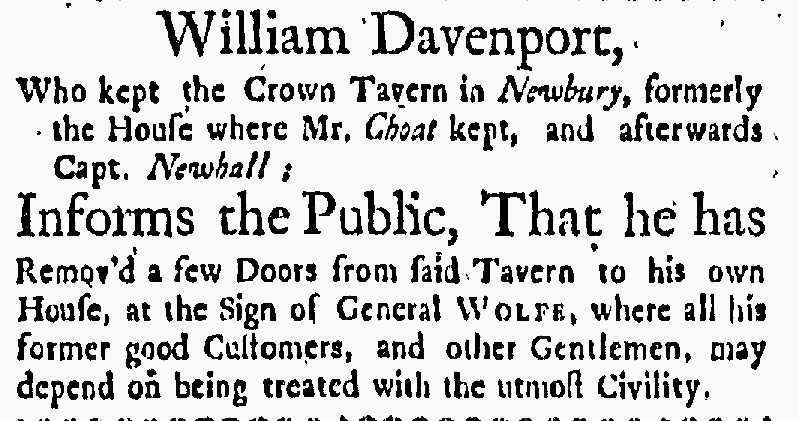
See "In Public Houses: Drink & the Revolution of Authority in Colonial Massachusetts" David W. Conroy

From Swett family Papers 1670 March 12: Stephen Swett sold his house to Hugh Marsh. [Rolfe, papers. 10: copy of the agreement.] "At last, Hugh Marsh consented to leave his farm and commence tavern keeping on a large scale in the year 1670. His stand, which was, for many years, a noted place, was near the head of Marlborough street, on the spot where Messr. John and Stephen Ilsley now reside." [Coffin's "Newbury" (1845), p. 71] "Stephen Swett's ordinary was afterwards known as the Blue Anchor Tavern. This house, built by him, is still standing and occupied, on the west side of High Street, Newburyport, near the head of Marlborough Street. It has recently been purchased by the Society for the Preservation of New England Antiquities." [Stackpole, p. 8., published about 1914; he includes a photograph of the house.]
According to Historic Homes and Institutions and Genealogical and Personal Memoirs
All of the four sons of Hugh March were officers in the colonial army during the French and Indian wars, one of them, Colonel John March (1658-I725) being especially distinguished as “the foremost military leader in New England up to the time of the Port Royal expedition,” I707, which he commanded, and “the failure of which may fairly be charged in part to the Governor, who sent him out, and to the officers of the ‘Deptford,’ which was the convoy of the expedition.” (Johnson’s Univ. Cyc.) ‘
Captain Hugh March JR Grave (1656-1727) married to Sarah Moody daughter of Caleb Moody and Sarah Pierce. Photo from Find A Grave Cindy - Living To Tell


John March colonial soldier, was born in Newbury, Mass., June 10, 1658 ; son of Hugh and Judith March. He received a good education and in 1688 was a captain under Sir Edmund Andros in the campaign against the French and Indians. He completed and commanded the fort at Pemaquid, Maine, 1692-95; was promoted major, and commanded the troops that defeated the Indians and checked the French army under Count de Frontenac at Damariscotta, Maine, in 1697. He continued a prominent officer in the Colonial army; attained the rank of colonel in the wars of 1703 and 1707, and commanded the expedition sent by Gov. Joseph Dudley against the fort at Port Royal, in twenty-three transports under convoy of the Deptford, an English ship of war. He landed his men and attacked the fort in accordance with the orders of Governor Dudley, but the tardy arrival of the Deptford had enabled the garrison to prepare, and being unsupported by the Deptford the expedition failed. He died in 1725.
Paul Turner of the Salisbury Historical Society in Salisbury, MA notes that Capt. John March was one of the most influential and important men next to Robert Pike in Massachusetts.
From "Ould Newbury" John J Currier
Early March Family Graves at the Bridge Street Cemetery in West Newbury Massachusetts taken by photographer Wayne Marshall Chase

Mrs. Robert C. Cheney, of Ring's Island, Salisbury, Mass., a descendant of Judith March, only daughter of Hugh March, Sr., has in her possession a copy of the above petition, evidently in the handwriting of Hugh March, with deeds and other papers relating to the settlement of the estate of Colonel John March.
It is evident from the preceding statement addressed to the court sitting at Ipswich, by Hugh March, that he was anxious to resume his occupation as innkeeper; and it also appears that "the hondred court" was not inclined to grant his request. In this emergency Hugh March applied to the General Court, assembled in Boston, for aid and assistance in procuring the desired license. In the court files at Salem is the following interesting order relating to this subject :— (NOTE Spelling Etc not altered from real doc)
Att A Generall Court at Boston, October, 1682.
An Answer to the petition of Hugh March. The Court being Credibly Informed that the petitioner hath been & is like to be a great Sufferer by being disappointed of keeping a house of publick entertainement, he having been encouraged thereto by the Towne of Newbery & others conseyned. and therefore layd out a Considerable estate to fitt & furnish himself for that Imploy, and doe therefore contend it to the Selectmen of that Towne and the court of that County to consider of his condition and toe seis him therein, and that he may againe be intrusted in his former imploymt in due time. That this is A true copie taken out of the Court Records.
Edw Rawson, Secret.
The court at Salem the 2S: 9: 82 prsing the above order, & alsoe the returne from the Selectmen of newbery, doe not se cause to grant the sd Hugh marches desire in granting him liscence.
At the April term of the court held at Ipswich in 1683 "Hugh March was licensed to keepe a house of publick entertainment in Newbury for a yeare." His wife, Dorcas (Blackleach) March, died Nov. 22, 1683 ; and he was again at liberty to hold property in his own name without fear of molestation. His license as innkeeper was renewed annually during the remainder of his life.
Dec. 5, 1693, he conveyed by deed to his son John March, of Salisbury, "houses, lands, meadows, fencing, goods, chattels, leases, debts, bills, bonds, plate, jewels, and rings; household stuff, apparrell, utensils, brass, pewter, and iron; bedding and all other my substance whatsoever"; the said John March to pay to Sarah March, wife of Hugh March, a certain sum annually, "and allow her the use of my old parlor and the chamber over it within my house in Newbury, and commonly called by that name, and the use of the well for necessary uses during her widowhood, . . . with liberty of making use of the middle room for household occasions." By the terms of this deed John March is also required to pay over to the children and grandchildren of Hugh March certain specified sums of money (Essex Registry of Deeds, book 10, page 52).

Photo from blog Trip 128: Salisbury, Massachusetts In My Footsteps Christopher Setterlund
Captain John March, at the date of the above conveyance, was living in Salisbury, where he owned a large farm. He subsequently purchased several tracts of land in Newbury, and among them a farm of nearly one hundred and fifty acres at Birchen Meadow, so called. The boundaries of his estate in the immediate vicinity of the old tavern are somewhat vague and uncertain. It is probable, however, that the westerly limit extended to, and perhaps included, the high land that is known as March's hill.
Oct. 25, 1687, during the administration of Sir Edmund Andros, Captain John March was granted the right to maintain a ferry over the Merrimack River "from warehouse point, so called, in the town of Newbury, to Ring's Island in the town of Salisbury." For the details of the prolonged controversy to which this grant gave rise the reader is referred to the sketch, on pages 55 to 80, inclusive, entitled "TheFerry at Carr's Island." Some arrangement was evidently made with Captain Edward Sargent, who was a licensed innkeeper, to take charge of the newly established ferry. As agent or lessee, it was under his care and control for many years.
July 15, 1690, John March was appointed captain, and ordered to enlist a company for the Canada expedition. In 1697, with the rank of Major, he had command of the forces engaged in the attack on the Indians at Damaris cove, on the coast of Maine. In 1703, he petitioned the General Court to grant him compensation for losses sustained in the defence of Casco fort; and November 20, of the same year, "the General Court granted to Captain John March fifty pounds in consideration of the brave defence of his majesty's fort at Casco Bay, when lately attacked by the French and Indian enemy, and of the wounds he then received." A few years previously, April 17, 1700, Captain John March had given a mortgage deed to John Wainwright, of Ipswich, of the following described property, namely, "four acres of land, bounded easterly by the street, northerly by the land of George March, westerly and southerly by land of James Coffin, with house and outhouses conveyed to me by my father, Hugh March, senior, Dec. 5, 1693 " (Essex Deeds, book 14, page 16). This mortgage was discharged May 9, 1704 (book 16, page 16).

During this year or the year following he removed to Falmouth, now Portland, Me. He was evidently engaged in military service, and was promoted to the rank of lieutenantcolonel. July 23, 1705, he sold to the town of Newbury the ferry over the Merrimack River, granted to him during the administration of Sir Edmund Andros, described as follows (Essex Deeds, book 19, page 48): —
Lt. Col. John March of Newbury, now resident in Falmouth, York County. gentc" for .£240. conveys to Lt.-Col" Thomas Noyes, Esq., Majr Dan" Davison, Lt. Joseph Little, Mr William Titcomb, all of Newbury, a committee for the town of Newbury, all the interest and right, &c., which I now have or may have "in or to the ferry comonly calledMarches ferry, over Merrimack River, near the place where Capt Edward Serjeant now Dwells in Newbury afores'1, which ferry was first granted by Sir Edmond Andross & Councill unto y Said March at a councill held at y* Councill Chamber in Boston on Tuesday y* Twenty fifth day of octob1 1687, as by said act of Councill may appear. & confirmed & setled vpon Said March by y* Justices of y * County of Essex afores'1 y* 14"' of Novembr, 1687, & again Confirmed unto him at a Generall Sessions of y * Peace holden at Ipswich for the County of Essex, march 28"' 1 704, & was Late in y* Tenure & occupation of Cap' Edwd Serjeant afores'1," except the gratuitous right of ferriage of the grantor and his perticular family & Horses & Cattle over s'1 ferry for 22 years.
After his return to Newbury Colonel March was busy and active in public affairs. His will, dated April 18, 1707, and proved Aug. 25, 1712, gives to his eldest son, John, two and one-half shares, to son Hugh one and three-quarters shares, daughter Abigail one share, and daughter Elizabeth one share of all his real and personal estate. In the inventory of his estate, "his Great Dwelling House, orchard, outhousing, with abt 3f acres adjacent the homestead," are valued at ^350; and "the dwelling house y' Capt. Henry Lyon lives in, outhousing, with abt 3 acres adjacent of yc homestead," are valued at ^200.
Captain Henry Lyon was licensed as an innholder for the years 1712 and 1713, and evidently had charge of the old tavern when the will of Colonel John March was proved. From the records of the Court of General Sessions, held at Salem March 16, 1713-4, it appears that,
Capt. Henry Lyon having left Newbury *S: y house being y Anchor Tavern, which he had a lycense for, & y justices & selectmen of Newbury setting forth to this court that it is needfull that another person be permitted to keep yc s'1 house as an innholder, & having given their approbation that Mr John Clarke might be Lycensed to keep y s1' house. This Court doe Lycense y* s'1 John Clarke to be an Inn holder in said house till June Court next, he making good s'1 Capt. Lyons excise to y province.
John Clarke probably continued to serve as innholder until 171 5. Some time during that year the property passed into the hands of John Wainwright, but the deed transferring the title does not appear to have been recorded.
At all events, John Wainwright, late of Ipswich, now of Boston, merchant, sold to Samuel Sawyer, of Newbury, innholder, Dec. 21, 171 5, for ^160,
Two and three quarter acres of land, commonly known as the Blue Anchor Tavern, with the Mansion house, barn and stables, bounded south easterly partly by land now belonging to John Woodbridge and John March and partly by land belonging to James Coffin, and westerly and northwesterly by y' land of y" heirs of Insigne Henry Lunt. late of Newbury, deceased, northerly by y" land of Benjamin Morse, tercius. and north easterly by y* street or country road (book 2S. page 78).
Samuel Sawyer was a licensed innholder from 1693 to 1716, and very likely rented and occupied the " Blue Anchor Tavern " while Colonel John March was actively engaged in the service of the colony on the eastern frontier.'
March 3, 171 5-6, Samuel Sawyer sold to his son Benjamin "one mansion or dwelling house with 2 J acres of land in Newbury, known by the name of The Blew Anchor Tavern," bounded and described substantially as in the deed above quoted (book 28, page 164).
Oct. 2, 1718, Benjamin Sawyer, of Newbury, weaver, for ^155, conveyed to John March, of Salisbury, "house and 2$ acres of land in Newbury aforesd, comonly known by y* name of y* Blew Anchor Tavern, together with all y* houses, outhouses, Barns, Buildings, stables, orchards, Gardens, &c.," bounded and described substantially as in the deed from John Wainwright to Samuel Sawyer (book 36, page 71).
Obit for Rev John C March September 29, 1846 Newburyport Herald
Obit for Rev John C March September 29, 1846 Newburyport Herald


The line of descent from Hugh March and Judith, his wife, to Francis Andrew March, is as follows: 2. Hugh, b. Newbury, Mass., Nov. 3, I656; captain in French and Indian war; m. I683, Mrs. Sarah Moody. 3. Samuel, b. Newbury, Mass., March 2, 1689; m. Ann Tappan (1686-1724), daughter of Jacob and Hannah Sewall Tappan. 4. Daniel, b. Newbury, Dec. 26, 1717, moved to Sutton in 1753, and bought a tract of land three miles long, beside the Blackstone river, in center of what is now Millbury. 5. Tappan, b. in Sutton (Millbury), 1749, died Oct. 2, I809; m. Hannah, daughter of Nathan Patch
6. Andrew, b. in Sutton (Millbury), Oct. I3, 1798, died at Albion, Pa., Feb. 20, 1874; m. Nancy Parker, of Charlton, Mass., who died Feb. 20, 1830, aged 25.
7. Francis Andrew March.
He graduated from Amherst College in 1845, and received a M.A. degree from Amherst in 1848. After studying law and teaching for three years, he became instructor at Lafayette College. March occupied the chair of English language and comparative philology at Lafayette College, in Easton, Pennsylvania, from 1857 to 1907. It was the first post of its kind. March was one of the first professors to advocate and teach English in colleges and universities. March applied the methods of studying the Latin and Greek classics towards the study of English literature, and led the way for the first scientific study of the English language.
In addition to English, March also taught French, German, Greek, Latin, botany, "mental philosophy", political economy, the Constitution, and law.
He also served as president of the American Philological Association (1873–1874; 1895–1896), the Spelling Reform Association (after 1876), and the Modern Language Association (1891–1893).
March was the first American superintendent over the volunteer reading program of the Oxford English Dictionary, thus providing valuable support to James Murray in the compilation of this monumental work. March married Margaret Mildred Stone Conway March (1837 - 1911) daughter of Walker Peyton Conway (1805 - 1884) and Margaret Eleanor Daniel Conway (1807 - 1891)
He was the father of historian Francis Andrew March and General Peyton C. March who was chief of staff of the United States Army during the First World War.
Other Children Thomas Stone March (1868 - 1939) Alden March (1869 - 1942) Moncure C. March (1872 - 1945) John Lewis March (1873 - 1952) Mildred March (1875 - 1959) Margaret Daniel March (1877 - 1923)

From "Daughters of the American Revolution Lineage Book" Volume 10 Descendant of Hon. Thomas Stone, of Maryland; Capt. Valentine Peyton, of Virginia.
Daughter of Walker Peyton Conway and Margaret Eleanor Daniel, his wife.
See " Virginia Soldiers in the Revolution: Summary of Statements Made by Soldiers Who Served in the Revolutionary War from Verginia' Either in the Continental Line or the Virginaa State Line The Virginia Magazine of History and Biography Vol. 22, No. 2 (Apr., 1914), pp. 177-186
Granddaughter of John Moncure Daniel, M. D., U. S. A., and Margaret Eleanor Stone, his wife; John Moncure Conway and Katherine Storke Peyton, his wife.
Gr.-granddaughter of Thomas Stone and Margaret Brown, his wife; Dr. Valentine Peyton and Mary Butler Washington, his wife.
Thomas Stone, the signer of the Declaration of Independence, died at the age of forty-four and is buried at Havre de Venture. His epitaph reads, "He was an able and faithful lawyer, a wise and virtuous patriot, an honest and good man."
Valentine Peyton served as surgeon in the Continental Line and as captain of the Third Virginia Regiment. see Peyton Society of Virginia