Showing posts with label John Quincy Adams. Show all posts

Thursday, August 14, 2014

Joshua Freeman A Tavern & Some "Dirty Dancing"


In 1766  Freeman's tavern stood on the corner of Fish, now Exchange, and Middle streets. The people of the province of Maine were far from being so strait-laced in their notions as the Plymouth folk, still there was a law in Falmouth against dancing in places of public resort. The "quality," as they were styled, occasionally had dancing parties in Freeman's tavern. For this they and their wives were indicted in 1766. Theophilus Bradbury, one of the party+, a lawyer of note, got them out of the legal trap under the plea that the room in which the dance took place was hired by private individuals for the season, consequently could no longer be considered a place of public resort, but a private apartment, and that the persons there assembled had a right to meet and dance in their own room. The plea was sustained by the court. Very likely the honorable justices were wont to take part in the dances. (Centennials of Portland, Charles Parker Ilsley)

At April term 1766, Samuel Waldo, Theophilus Bradbury, Esquires, Doctors Nathaniel Coffin and Edward Watts with their wives, Nathaniel Deering and wife, John Waite and wife, and several other ladies and gentlemen (I believe 18 in all) were indicted for dancing in the house of Joshua Freeman, innholder, on the 9th of December 1765, being a tavern, and a licensed house, contrary to law, and in evil example, &c. The record informs us that the said Theophilus Bradbury, for himself and his wife, and all the rest, by said Bradbury, their attorney,' come and say that the said Joshua Freeman, on the first day of December A. D. 1765, demised to the defendants the northeasterly chamber in his house, mentioned in the bill of presentment, to hold to them, for their sole use, whenever they should have occasion therefor, for the space of three months from the same day, and for so long afterwards as both parties should please; into which chamber they entered, received the keys, and full possession thereof, and held the same accordingly until this day; and being so possessed, they, in their said chamber, on the ninth day of the same December, did dance, as they lawfully might do, which is the same dancing mentioned in the bill of presentment, and this they are ready to verify—wherefore, &c. And Mr. David Wyer, attorney for our sovereign Lord the King, comes, &c. and says that the plea aforesaid of the said Samuel Waldo and others, and the facts therein stated, are not a sufficient answer in law to the bill aforesaid, wherefore, &c. Joinder in demurrer. The court adjudged the plea a sufficient answer, and that the defendants go without day." (An Address to the Members of the Cumberland Bar: Delivered During the Sitting of the Court of Common Pleas, at Portland, June Term, 1833)

Here s the story told by Sylvester in New England Magazine 1892


But the time has come for the festivity to begin. There is a hush in this youthful hilarity that is merged in the bustle incident to the more immediate preparations for a stately minuet or a more rollicking measure still Over all there sounded:
“ The music of a violin.
The fireligbt, shedding over all
The splendor of its ruddy glow,
Filled the whole parlor large and low; It gleamed on wainscot and on wall," —
and revealing the flickering of the homemade “ tallow-dip," it shone into the faces of fair women, only to find a rival warmth in the ruddy glow of their cheeks. It was a dissipation that was kept up into the wee small hours of the morning, if the chronicler of these events is to be believed,—and much to the scandal of the community; for to the Orthodox mind in those days, dancing was a lure of the fiend. In Provincial Falmouth dancing was prohibited by law, in places of “public resort.” The “quality” in town held their dances at Freeman’s tavern, an old-time hostelry of most excellent repute, and on one occasion, as early as the first year of the Revolution, the dancers were indicted.

Among them was Theophilus Bradbury, who afterwards became a distinguished lawyer, and with whom the celebrated Theophilus Parsons studied in after years. Bradbury appeared for the respondents with the ingenious defense that as the dancers had hired the room for the season, it became a private apartment and was not a place of “ public resort.” The court sustained the counsel's view of the case, and the “ quality " danced to their heart's content ever after.

Sitting here, with the sound of the fire music within, and the whistle of the robin in the orchard trees without, my hostess told a story connected with the inn, of a couple of not over-hardened gamesters and their experience with the occupant of the Bradley parsonage.


It was on a Saturday night. In this self same room it may have been, that a group of revellers, betwixt their hot toddy, their card-playing and their wooing of the fickle goddess, with a constantly increasing pile of winnings on one side and a constantly lightening purse on the other, grew so oblivious to churchly precept that the game lasted well into Sunday morning. A look at the tall clock in its corner in the hall told them what, with all its loud striking, had gone unheeded, that midnight had come and gone,—a revelation not unmixed with twinges of conscience, that caused the cards at once to disappear. With an extra mug of flip around, they said their good-night.

“Alone remained the drowsy squire,
To rake the embers of the fire,
And quench the waning parlor light;
While from the windows here and there,
The scattered lamps a moment gleamed,
And the illumined hostel seemed
The constellation of the Bear, Downward, athwart the misty air,
Sinking and setting toward the sun.
Far off, the village clock struck one."

Not all of those midnight revellers took their candles from the narrow mantel to light them to bed along the big hall and up the stairway. Two of the hilarious company, wishing their sleepy landlord a good night's rest, went out into the dark highway that crept past Parson Bradley’s. With uncertain steps they kept the faintly discernible track, down the hollow and up the hill between the inn and the old gristmill brook that went down to the marsh as noisily in the dark as in broad daylight, as if it knew the way so well it had no need of eyes,— which was more than could be said of the two scapegraces who went creeping over it by the help of the sagging handrail of its old bridge.


The nearer they came to the parsonage, the livelier grew their consciences at having trespassed upon the Lord's time. After a brief debate, and not without misgiving, they concluded to call up the par~ son and divide the spoils with him, thinking that by turning into the church treasury a part of their ill-gotten gains, partial absolution might be secured. They plodded along through the dark and over the hill by the Tate house, past its black elms, glancing no doubt at its gloomy windows, as if expecting some uncanny thing, perhaps some old woman's ghost, might be there to cast its glowering eyes upon them,— for those were times when uneasy spirits went abroad o'nights. They kept up their courage by dint of loud talk and an occasional pull at the black bottle, dreading most of all the parson’s scathing rebuke, which would undoubtedly greet their endeavor to make him a party to their unchristian practices. The parson’s slender wicket rattled loudly as they opened it, and they made a furious din with the brazen knocker at the door, whereat the preacher, noted for his dry sayings, his keen satire, and his eccentricities, came to the door to listen to the midnight confession. What they said is not recorded, but hardly had the old man received the silver, when he astonished his callers by his mild acquiescence and the half-approving inquiry:
“Well, gentlemen, why did you not play longer?" Well John Quincy Adams seems to be in favor with Bradbury on the matter:


From John Q Adams Journal November 1786 as recorded by Proceedings of the Massachusetts Historical Society


29th. It snow'd part of the forenoon; then turn'd to rain, and, after making the streets very disagreeable, cleared up in the afternoon. I dined with my brothers at Mr. Bradbury's. We had some conversation upon the subject of Ben Hooper's funeral. I could not agree in sentiment with Mr. Bradbury. I told him that although I abhorr'd the action itself as much as any one, yet after a man was dead to refuse to attend his funeral would only be an insult upon the feelings of his friends, without being any kind of punishment to him. And indeed I cannot but think that laws against suicide are impolitic and cruel, for how can it be expected that human laws, which cannot take hold of the offender personally, should restrain from the commission of this crime the man who could disregard the natural and divine laws, which upon this subject are so deeply imprinted upon the heart? When we consider too how easily such a law may be evaded, how many ways a man might put a period to his own existence without exposing himself to the severity of any law that the human fansy could invent, we can only suppose that these punishments must fall merely upon a thoughtless youth, or upon one ignorant of the existence of such regulations.

Mr. Bradbury*, however, thinks differently and is perhaps in the right. I pass'd about an hour in the evening with Putnam; he then went with G. Bradbury and my brothers into a company of young ladies; and I cross'd the street and sat till nine o'clock with my friend Thompson. Tom lodg'd with me.

30th. I went up to the office in the morning, and sat a couple of hours; but I felt restless and dissipated. I could not study, and therefore walk'd down in town and saunter'd about. Dined with G. Bradbury and Charles at Mr. Hooper's. He is very sanguine in his hopes for the adoption of the Constitution. Pass'd the evening at Mr. Bradbury's. Dr. Smith and all his family were there. We had some music in the beginning of the evening, and afterwards play'd a number of very amusing sports, such as start; what is it like; cross questions; I love my love with an A; and a number more. My opinion of such diversions I have already given, when it was confined to a number of young persons; but that the most inexcusable levities of youth should appear in the garb of old-age is something that calls for more than disapprobation, nor will a grey hair'd trifler excite our pity merely, but must raise our indignation and contempt. Mr. Bradbury,1 however, is a very respectable man; and, as this conduct has here the sanction of custom, it is not him but the manners of the times that I blame.

Mr. Theophilus Bradbury Was apparently fond of a social good time. In 1766, it is said, he and his wife " with several leading citizens of Falmouth " (Portland) were indicted for the crime of dancing at a tavern; but won the case in the courts on the plea that the room was not a place of public resort because hired for private purposes, etc. W. B. Lapham, Bradbury Memorial, p. 89.


 Joshua Freeman (1730-1796) built the house at 25 Granite Street, formerly 210 Deering Avenue.
Dr. Stephen Cummings owned the house from about 1835-1852 and Jeremiah Dow owned it from 1852-1886.
When William S. Denny owned it from the mid 1890s to the early 1900s, he remodeled the home and named it "Bethwood." Maine Memory
   
                                          Samuel Waldo (1741-1770)

Obit mentioning tavern Joshua 's son in law. Joshua Freeman Weeks Thursday, October 14, 1875 Portland Daily Press (Portland, ME)


Sunday, July 6, 2014

Mary Frazier and John Quincy Adams

Miss Mary Frazier, daughter of Moses and Elizabeth (Hallantine) Frazier, born March 9, 1774. She was also known as "Maria" or "Polly" and was noted as one of the counties most beautiful lasses and J Q Adams was smitten with her! See Quinn Bradley Blog on Frazier Family Life in a New England town, 1787, 1788: diary of John Quincy Adams while a student in the office of Theophilus Parsons at Newburyport: 

Home built by Theophilus Parsons in 1789 on the corner of Green and Harris Streets. Courtesy of Joe Callahan. From Clipper Heritage Trail

On the 8th of December J. Q. Adams returned to Newburyport, resuming his studies in the office of Mr. Parsons. His diary was now reduced to daily memoranda of a single line each, and so continued until the following September (1789). The winter of 1788-1789 was passed partly at Newburyport and partly at Braintree, reading, riding, skating, and "hunting for partridges and quails," with occasional social entertainments. Among the law books now read, he noted Barrington's "Observations on the Statutes " and Buller's "Nisi Prius."  Picture from John Q Adams by request


He became also intimate with the family of Mr. Moses Frazier, of Newburyport, one of whose daughters, Mary, especially attracted him. Rumors of a marriage engagement were in circulation; and, years afterwards, there appeared in a Newburyport paper a highly colored account of the incident, in which Mr. Adams, then ex-President and a man of seventy, was made to declare "that in all which constitutes genuine beauty, loveliness, personal accomplishments, intellectual endowments and perfect purity of life and heart, Miss Mary Frazier excelled " anything he had ever known of " the most attractive and recognized beautiful among the female sex in Europe and America." And he declared that he "loved her then," and loved "her memory " still. check out  "All my hopes of future happiness center on that girl."

The writer of this over-colored and extremely apocryphal narrative then went on to add that J. Q. Adams acknowledged to him an engagement with Miss Frazier, but on the understanding " that should either see cause to change their mind they were left free to do so. The direct cause of the breaking off of the engagement [was] because of the very proper interference and advice of Miss Frazier's family and friends. They charged that Mr. Adams was quite young [twenty-two], without a profession, and with no very good prospects as to the future," etc. And, Mr. Adams is alleged to have added, "In this advice they were about right, for I then certainly had no very flattering prospects, near or remote." The writer then asserted that the tradition in Newburyport was that Miss Frazier remained unmarried until after the news reached her of the marriage of Mr. Adams, in London, in 1797, seven years later.

Concerning this episode, Mr. Adams at the time wrote to his mother: "But upon one subject, on which from a passage in your letter I am led to suppose you are under some apprehensions on my account, I think I can safely assure you they may be quieted. Tou may rest assured, my dear Madam, that I am as resolutely determined never to connect a woman to desperate fortunes, as I am never to be indebted to a woman for wealth. The same spirit, I presume, will operate equally to prevent either of these cases, and you shall never be requested for your consent to a connection of mine, until I am able to support that connection with honor and independence." On the 9th of August, 1789, his friend and fellow student, William Amory, was married to Lucy Fletcher. Meanwhile his own health seems to have been in great degree restored, for he notes numerous meetings of the "club" in which he participated, sociable evenings, "noisy walks" and serenades "till three in the morning." One day they indulge in "an after dinner dance, company small but agreeable"; and, the next, he sees "the ladies' scheme for a sail fall through." Altogether, the student life at Newburyport seems not to have been devoid of attractions. Finally, after one of many evenings passed at Mr. Frazier's, the more detailed diary reopens.]
Recollections of Newburyport by James Morss, "Newburyport Herald," June 30, 1864. [John Q. Adams; Mr.Adams Newburyport]
Tuesday, January 10, 1854 Cayuga Chief (Auburn, NY) Volume: 6


An entry from his journal early on: June 15 1787:
Charles went to Boston this morning, and return'd at night. After prayers I went with Cranch to Mr. Williams's. We walk'd with the young Ladies. Miss Frazier from Boston was of the party: she appears sensible and agreeable. We went and viewed Mr. Brattle's gardens, and ponds and other conveniences, which his ingenuity has invented for the gratification of his sensuality. This man, who enjoys an handsome estate has pass'd his whole life in studying how to live; not in a moral but in a physical sense. The ladies were disappointed when they found he had very few flowers in his garden, but it was observ'd that he was so much engaged in the service of his palate, that he could have no leisure to give his attention to any one sense in particular. Some pages from John Quincy Adams The Critical Years 1785-1794 (1962)


John Quicy Adams Date: Tuesday, September 20, 1864
Paper: Boston Daily Advertiser (Boston, MA) Volume: 104 Issue: 68 Page: 2


In a letter written August 1794 J Q A expressed gratitude the he escaped, "a web in which my own heedless passion had precipitated me."  However, he adds his "lingering fondness" and forgives any wrongs Madame Frazier, "who never shared his sentiments" and may have done during his time of a heart throb. See

Mary Frazier married Daniel Sargent noted in Reminiscences of Lucius Manlius Sargent: with an appendix containing a genealogy of his family, and other matters.
Daniel Sargent (Daniel, Epes, William, William1), b. June 15, 1764; d. in his mansion-house, Mt. Vernon Street, Boston, April 2, 1842, aged 78; m. Mary Frazier, of Newburyport, Dec. 4, 1802—a lady of beauty and intellect. She d. July 28, 1804, at Wrentham. having been at Newport for her health. The issue of this marriage was Maria Osborne, b. Dec. 22, 1803, d. March 7, 1835; and Daniel Sargent, b. Nov. 9, 1825. She m. Thomas B. Curtis, merchant, of Boston, Dec. 8, 1824. They had two children: Daniel Sargent, b. Nov. 9, 1825, and Mary Frazier, born March 5, 1827.

Mr. D. Sargent was a merchant. His wife died July 28, 1804—a pleasing and beautiful woman, to whom he was much attached; and he remained a widower thirty-eight years, to Ins death. He devoted himself to the supsort of her mother and two sisters, and after his father's death, took care of his own mother. He was State Treasurer 1817-1822—live years. Much respected for his virtues and piety.

Thursday, July 3, 2014

John Quincy Adams & Davenport's Newbury MA

In the John Quincy Adam Papers there are a few journal entries mentioning Newbury and the Davenport's.


On March 12 1788 I Dined with Townsend at Mrs. Hooper's. Amory went to Portsmouth on Monday, with several of his friends. They return'd this day to dinner at Davenport's. We called to see them; and sat with them drinking and singing till five o'clock, when they went for Ipswich. I pass'd the evening with Pickman, at Doctor Smith's. Townsend, went there with us, but found himself so unwell, that he went home very early. His cough has return'd, with several disagreeable symptoms. I fear exceedingly, that he is not long for this world.
We play'd whist an hour or two at Dr. Smith's and between 10 and 11. retired.

John Quincy Adams was born in Braintree (now Quincy), Massachusetts in 1767. His early education,which he received from his Father was mainly in the subject of mathematics, languages, and the classics. He graduated from Harvard College in 1787 and studied law in Newburyport, Massachusetts under the guidance of Theophilus Parsons. In 1790 he began the practice of law in Boston. He was elected to the U.S. Senate in 1802. He left his pipe in Newburyport by Jack Garvey

March 19 1788
The weather was dull, gloomy, and part of the day rainy. Amory invited me to dine with him and Stacey and Azor Orne at Davenport's, but I did not feel inclined that way. I call'd at Mrs. Hooper's in the evening and spent a couple of hours with Townsend. The lads who dined at Davenport's warm'd themselves so well with Madeira, that at about seven o'clock this evening, they all set out upon an expedition to Cape-Ann, to attend a ball there this night. Twenty seven miles in such weather and such roads after seven o'clock at night, to attend a ball, would look extravagant in a common person; but it is quite characteristic of Amory.

November 5 1787 

I attended at the Office. Amory was there. Return'd yesterday from Salem. Townsend went to Boston last week, and has not yet return'd. In the afternoon, we attended the funeral of Mrs. Davenport a sister of Mr. Parsons. She died of a consumption a few days since. Little, and Thomson pass'd an hour with me in the evening, after which, I went with the latter to Mr. Atkins's. Thomson was much affected, on hearing of the death of one of his school-boys; who died of the Scarlet fever, after a very short illness. I cannot write yet in the evening, for want of fire.
Judith Parsons (Theophilus Parsons' sister) was married to Anthony Davenport, son of William Davenport and Sarah Gerrish Davenport.


John Quincy Adams From the original painting by John Singleton Copley, in the Museum of Fine Arts, Boston. Autograph from
the Chamberlain collection, Boston Public Library.

Sunday, March 23, 2014

He left his pipe in Newburyport

by Jack Garvey Columnist Leader of AISI Newburyport News He has been a street-piper in Newburyport since 1982, performing on the Inn Street Mall and Market Square as weather allows. He can be reached at hammlynn@yahoo.com  Pictures added by Melissa Berry

                              
               “You will never know how much it has cost my generation to preserve 
                 your freedom. I hope you will make good use of it.” ~John Q Adams


Presidents Day, Monday, Feb. 17 2104

Our Newburyport Public Library once “entertained” three Revolutionary heroes and the infamous pair of Benedict Arnold and Aaron Burr.

Sixth name on the lawn plaque belongs to our sixth president, John Quincy Adams, just nine when dad championed the Declaration drafted by a reticent Thomas Jefferson.

Unlike the other five, the younger Adams lived in Newburyport, an apprentice for over two years to Theophilus Parsons, an architect of Massachusetts’ Constitution and later Chief Justice of the Commonwealth.

Adams was engaged to local girl Mary Frazier until her parents broke it off because they thought he had no prospects.

Only in Newburyport.

Perhaps the Fraziers worried over one of Adams’ youthful pastimes. When he arrived here in 1787 as a 20-year-old Harvard grad, he brought with him a musical instrument:

A flute.

Adams’ biographer says he “fell in with a circle of fiddlers and flautists,” frequently playing in public houses, most often the legendary Wolfe Tavern—a tradition now carried on every Wednesday evening and many Sunday afternoons downtown in the Port Tavern.

But there’s no mention of music by the time Pres. Madison sent him to Russia. As minister to Czar Alexander, Adams redeemed himself from a failed stint as a US Senator.

“Failed” is a relative term for a legislator who backed Jefferson’s embargo against an England that mocked our independence with the “impressment” of American sailors into the British navy.

The embargo cost Massachusetts manufacturers dearly, and just as today, putting principle ahead of economic interest was political suicide.

America’s Revolution needed a second act. To win the War of 1812, Adams wrote accords in St. Petersburg and Ghent well before January, 1815, when Andrew Jackson fired that gun and the British kept a’comin’.

Like father, like son: In separate acts each played a lead. The younger Adams’ triumph was gaining Russia’s alliance. Following Napoleon’s retreat from Moscow, England had to accept that a very powerful friend had our back.

Adams’ redemption came when Pres. Monroe made him secretary of state. According to Monroe’s biographer, Adams wrote “the core provision” of the Monroe Doctrine “ending foreign colonization in the Americas.”

Like father, like son: They state the case, a Virginian gets the credit.

A Boston newspaper dubbed Monroe’s two terms “The Era of Good Feeling,” but friction between North and South ended that by the time Adams defeated Jackson—and Henry Clay—in the 1824 presidential race.

Obstructed from the start by a bitter and ambitious Jackson, Adams’ one-term presidency was hardly the stuff of Mount Rushmore.

Old Hickory’s supporters termed Adams’ appointment of Henry Clay as Secretary of State “The Corrupt Bargain,” a theft of the election.

Thus began a four-year smear campaign. Like then, like now: Claims that Adams used prostitutes to strike an alliance with Russia and secure the Treaty of Ghent were as foam-mouthed as “death panels” and “Obamunism” today.

The treaty thus discredited, their slogan for 1828’s rematch gained traction: "Adams who can write, or Jackson who can fight?"

Undeterred, Adams then served Massachusetts and the abolitionist cause for 16 years in the House of Representatives, waging a long and successful war against a “gag order” preventing any discussion of slavery in Congress.

His 1841 victory in the Supreme Court would inform the 1997 film, “Amistad,” with Anthony Hopkins in a penetrating turn as Adams.

Only a stroke on the House floor could stop him. He was 80.

If another Rushmore commemorated work after leaving the White House, Adams would have the peak to himself with Taft, Hoover, and Carter candidates for the nearest ridge.

A new book, American Phoenix, details the roles of John Quincy and Louisa Adams in gaining the Russian alliance, an account owing much to Louisa’s diary.

An active diplomat in fact if not name, Louisa rivals the more celebrated Abigail for prolific and insightful accounts. Like mother, like daughter-in-law.

They all kept voluminous diaries, but after Adams’ Newburyport years none, not even his own, ever mention that flute.

At the time, Adams reported that the “fiddlers and flautists” went on “frolicks” to the homes of young women—Rebecca Cazneau, Sarah Wigglesworth, Elizabeth Coates, and a "Miss Fletcher.”

Serenades through the windows.

And so the sixth president of the United States was a street piper.

Only in Newburyport.

A page of flute music copied by John Quincy Adams when he was studying the flute during his student days at Harvard University (1786-87).


SOURCES:

American Phoenix: John Quincy and Louisa Adams, the War of 1812, and the Exile that Saved American Independence (2013), Jane Hampton Cook

John Quincy Adams (2012) and The Last Founding Father: James Monroe and a Nation’s Call to Greatness (2009), Harlow Giles Unger

John Quincy Adams: A Public Life, a Private Life (1997), Paul C. Nagel.

Ecstatic Nation: Confidence, Crisis, and Compromise, 1848-1877 (2013), Brenda Wineapple. Long introduction makes a convincing case that JQA’s funeral was a landmark event in American history, his death a turning point in relations between the North and South.

Profiles in Courage (1955), John F. Kennedy. An account of JQA’s support of the Louisiana Purchase and Jefferson’s embargo against the wishes of New England Federalists, especially merchants, is the first of this book’s eight chapters.

For a richly detailed and most engaging biographical sketch of Theophilus Parsons and for a history of the Wolfe Tavern, see www.ancestoryarchives.blogspot.com and type the names into “search site.” Kind thanks to fellow As I See It columnist Melissa D. Berry for these leads.

Saturday, November 23, 2013

Women Organized Against Slavery, 1688-1870

A Share from author & historian Larry Ceplair and a chapter his unpublished manuscript 


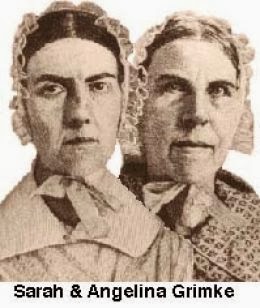
Following the women’s national antislavery convention, the Grimké sisters (Angelina & Sarah) began their relatively short lecturing career, in Massachusetts. Between June and November 1837, they spoke on the average of four times a week, in sixty-seven towns, to some 40,000 listeners.1 They inspired thousands of women to sign petitions and hundreds to join or organize antislavery societies. John Quincy Adams credited them “for a vast proportion of all petitions coming from their sex in New England, on the subject of Texian annexation,”2 and at least twenty-five new female antislavery societies formed in Massachusetts during their sojourn there (May 1837-April 1838).


Lidian Jackson Emerson (September 20, 1802- November 13, 1892) Daughter of Charles Jackson and Lucy Cotton Jackson. Second wife of of American essayist, lecturer, poet and leader of the nineteenth century Transcendentalism movement, Ralph Waldo Emerson.
In Concord, following the Grimkés second appearance there, in early September, Lidian Jackson Emerson (1802-92), the second wife of Ralph Waldo Emerson, wrote to her niece:
They have passed [this] week in Concord and been well received. They dined & took tea with [me] one day and it was a pleasure to entertain such angel strangers – pure & benevolent spirits are they. I think that I shall not turn my attention from the abolition cause till I have found whether there is not something for me personally to do and bear to forward it. I hope you will read any books or papers on the subject that you may meet with – if you can do nothing more for the oppressed after you have considered their case and become interested in it you can pray for them.3
She became one of the most active members of the newly formed Concord Female Anti-Slavery Society, and, according to her daughter: “She read the papers faithfully and their pro-slavery tone made her hate her country. She learned all the horrors of slavery and dwelt upon them, so that it was as if she continually witnessed the whippings and the selling away of little children from their mothers.”4 She also participated in their petition campaigns.


Garrison and fellow abolitionists George Thompson and Wendell Phillips, seated at table, daguerreotype, ca. 1850–1851

In Bolton, however, matters proceeded more slowly. Octavia Gardner described events there:
Until within two years, the subject of Abolitionism was not agitated, or perhaps named, at all, about us, or if named, but with sneers, by those who scarce knew its meaning. The first lecture was given here by Misses Grimké . . . . I was surprised at the general attendance of the people on the occasion of their Lecture for I knew there was prejudice among them in relation to the subject. It gave satisfaction & about twelve came forward & acknowledged themselves interested, sincerely, in the Anti Slavery Cause. I thought this a good beginning & a foundation & opening for a regular Society, & proposed it to them at the time, but they thought it inexpedient, & declined, urging as a reason, that the subject had not been generally discussed & public opinion was in opposition, & a society could not be supported satisfactorily to them. Misses Grimké lectured in many of the adjacent towns & those interested in them followed them & seemed much gratified. . . . Last autumn we had another lecture & a small society was formed, consisting of about twenty, men & women, & I hope that the result will prove it expedient as successful, but my fears are as numerous as my hopes.
Unfortunately, Gardner continued, “I am not free myself to act. My parents both of them were ever opposed to the subject of Anti Slavery.” She felt herself torn between her duty toward her parents and her duty toward the cause: “‘I’m in a strait betwixt the two.’”5

An increasing number of men joined the throngs of people eager to hear the Grimké sisters speak, and, inevitably, the question of the propriety of mixed audiences listening to female lecturers arose. It should be noted, however, that the critical case against women speaking in public, to mixed audiences was closely intertwined with antipathy toward Garrisonian abolitionism.


Catharine Esther Beecher (September 6, 1800 – May 12, 1878) Daughter of prominent New England minister the Rev. Lyman Beecher and Roxanna (Foote) Beecher. The first public attack came from Catharine E. Beecher (1800-78), the eldest daughter of Lyman Beecher (1775-1863), a long-standing foe of Garrison. (See Chapter Seven.) She noted, in a family circular letter: “I am just finishing a little vol[ume] entitled ‘An Essay on Slavery & Abolitionism with reference to the duty of American Females’ – done at father’s request & he is rejoicing over it greatly as it contains all he has been wanting to have said & could not get a chance to do it himself.”6

1Gerda Lerner, The Grimké Sisters from South Carolina: Rebels Against Slavery (Boston: Houghton Mifflin, 1967), 227.
2John Quincy Adams, Speech: John Quincy Adams of Massachusetts, Upon the Right of People, Men and Women, to Petition . . . (Washington, D. C.: Gale and Seaton, 1838; New York: Arno and New York Times, 1969), 78.
3Lidian Jackson Emerson to Sophia Brown, September 9, 1837, in Delores Bird Carpenter, ed., The Selected Letters of Lidian Jackson Emerson (Columbia, MO: University of Missouri Press, 1987), 60-61. See also, F. B. Sanborn, Recollections of Seventy Years (Boston: Richard G. Badger, 1909), 2:378-79, 446.
4Ellen Tucker Emerson, The Life of Lidian Jackson Emerson, Delores Bird Carpenter, ed. (Boston: Twayne, 1980), 83-84.
5Octavia Gardner to Ann Phillips, May 7, 1839, in Irving H. Bartlett, Wendell and Ann Phillips: The Community of Reform, 1840-1880 (New York: Norton, 1979), 198-200.
 6The letter is not dated, but appears to have been written in April 1837. It is in the Acquisitions Department, Stowe-Day Library, Hartford, CT.

Saturday, July 13, 2013

Gallows Hill: Where Were the Witches Hung? Salem, Massachusetts

A Share from Daniel Boudillion 
The story of 18 people accused as witches in the 1692 Salem Witch Hysteria ends as victims at the end of a hangman’s rope on Gallows Hill, otherwise known as Witch Hill or Witchcraft Hill. You would think such a public and awful event at that spot would have made such a huge impression on people that the location would live forever if only in infamy. Yet today, the exact location of the hangings, and even which hill is Gallows Hill, is not precisely known.
The town of Salem did set aside a public park but there is still historical debate about the location of the site and the clues lead elsewhere. Let us see where those clues lead.


On the Road with the Salem Witches
Many years ago as a young man I traveled the country for a year. With me I brought a number of books to keep me occupied, and included were several volumes on the Salem Witch Hysteria. These were fascinating accounts of the bitter land-feuds and ministerial issues that polarized Salem Village. This was to erupt in 1692, with a supernatural twist, into a seething cauldron of persecutions, accusations, and executions.
The entire drama captured my imagination and upon returning to New England, I visited Salem to see the locations of the many events.  High on my list was Gallows Hill.  Little did I realize it would be 20 years or more before I stood on the actual place where the hangings occurred. 
 Salem Town: Witches Old and New
Although I grew up in Middlesex County, I had never been to Salem in adjoining Essex County until I went on my pilgrimage there.  Driving in on Lowell Street from Peabody Center, I crossed into Salem at the Old South Cemetery.  Here a sign at the town line informed that I had entered The Witch City.  What were they trying to say by that, I wondered?
                          Door of Salem Police Car
By the time I got to Salem Common and had a walk around, I knew.  Salem had made a tourist trade off the Hysteria, even though virtually all the characters and action in 1692 took place in Salem Village, which was renamed Danvers about 50 years after the hangings.  Salem Common was a dangerous place.  It was where everyone walked their dogs, and back then there was no such thing as "scooping."  I quickly renamed the place Dog Poop Park, a name that has stuck long after the town bylaws have changed to address that situation.
Salem Common
Watch your step!

There was a terribly tacky Witch Museum in a wonderfully old gothic building.  I walked in and promptly walked out.  Around the corner was Laurie Cabot’s Crow Haven Corner.  In case you don’t know, Laurie Cabot is Salem’s official Witch.  It was an interesting little shop in a spooky old Colonial house.  The ambiance alone was worth every penny of the herbs I bought to be polite. 

   
Crow Haven Corner & Salem Witch Museum
The Salem Common and Pickering Wharf area were a co-mingling of historical Witch Hysteria sites, and modern Witch and New Age shops. 
   Is This Gallows Hill?
As delightfully "witchy" as the Salem Common area turned out to be, I directed my steps to Gallows Hill.  The directions I had led me to a park near Proctor Street, near the intersection of Boston and Bridge Streets.  The park was named Gallows Hill Park and a nearby water-tower had a large official witch riding a broomstick painted on the side. 

Salem water-tower with Witch Logo

This must be the place.  I walked up the hill to the official "hanging spot" and looked around.  The view was magnificent.  But although it was an impressive location, and even a satisfying one, it simply did not line up with the facts I had learned from my reading.
Official Hanging Place on Official Gallows Hill

For one thing, the hill was steep, and the thought of the accused being transported to the top in a cart, as it is known they were, seemed ludicrous upon having ascended the hill myself.  Also, I had learned that Benjamin Nurse had rowed a boat from a creek near the Nurse Homestead, out into the North River, and then to the base of Gallows Hill to recover his mother’s body.  It only took one look to see that there was no waterway contingent to the North River at the base of the hill I was standing on.  There was no water at or even near the base of the hill  The closest water was a canal over a quarter mile northeast. 


Sunrise at Official Gallows Hill

This left me confused.  In my opinion, the hill simply did not square with the historical record.  I left feeling misled and puzzled over it occasionally in the ensuing years, but with no better understanding. 
   Salvatore Trento Takes a Stab
Twenty years later I bought Salvatore Trento’s Field Guide to the Mysterious Places of Eastern North America and was intrigued about this once again.  Trento asserted that the official Gallows Hill was not the correct location, much as I had suspected.  He proposed a nearby hill as the site, complete with crevasse and gallows footing stones. 
So off I went in July of 2003 to locate this hill.  I found it easily enough south of the playing fields in Gallows Hill Park, and about 200 yards Southwest of the water tank.  It is a low grassy hill sloping down on its southern end.  The north end was a knoll with a crevasse just over the side (history tells us the bodies were dumped in such places).  The hill even had easy cart access up the south side from Colby Street, which looked liked it may have been a road back in the hanging times. 
Trento's Gallows Hill
I was pleased with this discovery, but the fact that this hill was even farther away from the closest waterway to North River was disconcerting.  It was over a half mile to the canal in fact.  I wondered how Trento reconciled this fact with the site’s location.

Top of Trento's Gallows Hill

So I went back to the books and refreshed my grasp of the known facts. Several things immediately invalidated the Trento site. First, he says the footing stones for the gallows are still visible. I have seen the stones he talks about, but the problem is that the accused were not hung on a gallows. Rather, they were hung from the branches of trees. Researchers have combed the meticulous records of the trial era, and not one mention was found of a gallows, and more tellingly, there is no record of the cost to purchase wood and construct such a gallows.

  
Correct and Incorrect Salem Witch Hanging Depictions

Also, the accused were brought to the top of the hill in a cart.  Although that is quite doable at the Trento site, the approach is from the Colby Street area, and it is known that the actual route went over Town Bridge at what is now the intersection of Boston Street and Bridge Street, and thence up the hill.  The Trento site does not fit with this fact either. 
Disappointed, I determined to find out once and for all the actual location. 
   Collective Amnesia
The more I researched and investigated, the more apparent it become that the official Gallows Hill site is only a probable site.  Rev. Charles Upham chose what is known today as Gallows Hill as the probable hanging site in his 1867 book Salem Witchcraft.  Historians and officials have followed his lead ever since, even though in Upham’s own words, "There is no contemporaneous nor immediately subsequent record that the executions took place on the spot." 


Upham's Gallows Hill

By the time of Upham’s writing, the actual site, wherever it was, had dropped from public consciousness.  The entire hanging episode was an acute embarrassment and shame to the community, and although the site was known to people, it was not publicly proclaimed or celebrated.  Rather, the subject, and therefore the location, was avoided and a kind of collective amnesia occurred in regards to the location.  People simply wanted to forget, and thus the location was "forgotten" too. 
However, it doesn’t help the tourist trade in modern Witch City to not have a true location of Gallows Hill.  Let the scholars argue as they will, but the hill that Upham chose has become the agreed-upon location for pragmatic ends, if nothing else. 
   The Perley Hypothesis
Fortunately, there are a number of scholars and researchers who have made a thorough examination of the facts and have come to conclusions more consistent with the historical record.
The most thorough and convincing presentation was made by Sidney Perley in 1921.  Like other researchers since, Perley was unable to "discover any tradition or other evidence which indicates that the alleged witches were executed on top of [Uphams’] Gallows Hill; and it is unreasonable in every aspect of consideration that they were." 
Perley did discover a number of important clues.  He was able to reconstruct the landscape and land ownership of Salem at the time of the hangings, making a number of maps.  A final and composite map of Salem circa 1700 drawn from his work was assembled by William Freeman and published in 1933. 
Freeman's 1933 map based on Perley of 1700 Salem showing actual Gallows Hill

Perley was also in possession of a letter written by Dr. Holyoke in 1791 with the following passage: "In the last month, there died a man in this town by the name of John Symonds, aged a hundred years lacking about six months, having been born in the famous ’92.  He has told me that his nurse had often told him, that while she was attending his mother at the time she lay in with him, she saw, from the chamber windows, those unhappy people hanging on Gallows Hill, who were executed for witches by the delusion of the times." 
Perley was able to locate the house Symonds was born in and found that it was impossible to see the supposed hanging site on the southern end of the hill, let alone Gallows Hill.  Ledge Hill completely blocks the view.  However, a nearer lower hill that better fits the facts of the circumstance was well in view.
Pearly's map showing actual Gallows Hill and Symonds sightlines
click for same map oriented to north

The known route from Salem to the hanging site is from Prison Lane (now St. Peter Street), then the long ride down Essex Street, thence a short ride on Bridge Street (now Boston Street), and over Town Bridge and then left to the hill. 
Town Bridge (now the Junction of Boston and Bridge Streets) was the recognized limit of the town in 1692.  The Sheriff of Salem, George Corwin, was given the authority to choose the execution location, the only stipulation being that it be done outside of town.  Immediately upon crossing Town Bridge, the lands to the left (including the official Gallows Hill) were all Common Lands.  Salem was built on a peninsula of land.  The only road out of town at the time was over Town Bridge.  Thus Corwin would have taken the condemned at least over Town Bridge.  Perley believes that Corwin did so, but no further.  Perley believes that Corwin took the immediate left after the bridge onto Proctor Street, at that time only a cart road skirting a low hill, and deposited the condemned at this little hill for execution. 
This site fits all the known facts.  First, it is over the town line.  Second, it is easily accessible by cart.  Third, the hill was of sufficient height that Salem was observable from it, a noted fact.  Forth, at the time, the North River extended in a large bay all the way to Town Bridge.  The modern canal is simply all that is left of the bay after it was filled in.  In 1692 the Town Bridge crossed a small arm of the North River bay called Bickford’s Pond.  Bickford’s Pond abutted the small hill.  This fits with the story that Benjamin Nurse was able to row his boat all the way to the base of the hill.  Fifth, the small hill supported substantial trees, whereas Upham reports of the official Gallows Hill site that the "scattered patches of soil are too thin to tempt cultivation."  Thus no trees, and recall that there is no evidence of an actual gallows erected - so how were they hung, then?  Sixth, the hill may be plainly seen from John Symonds’s birthplace, exactly as his nurse said. 
   Evidence of the Locust Trees
In 1747 locust trees had been planted in the area.  According to President John Adams, who visited "Witchcraft Hill" in 1766, "Somebody within a few years has planted a number of locust trees over the graves, as a memorial." 

Perley's sketch of actual Gallows Hill

Adams was incorrect about them being a memorial, however the clue of the locust trees led Perley to inquire of the owner of the small hill if locust trees had ever grown there.  Indeed they had, although recently cut down.  No locust trees or memory of locust trees were found on Upham’s choice of Gallows Hill.
   The Witch Tree
An interesting side note is that there was a so-called "Witch Tree" on the Perley site as late as 1793.  This tree was not connected with the hangings, but was rather of an odd shape.  It divided a foot or two above the ground into two trunks that then grew wildly apart, only to reunite into a single trunk several feet higher.  It was the custom among some Salem residents sometime after the hysteria to pass new-born babies through the hole to protect them from witches. 


Nurse family tradition is that when Rebecca Nurse was hanged on July 19, 1692, that her youngest son Benjamin, then 26 years old, rowed his boat under cover of darkness from the Nurse homestead to Gallows Hill to retrieve her body.  This is not as impossible as it might seem, even though it was a 6 mile one-way trip.  For one thing, it was not unusual for Salem Village farmers to row into Salem Town. 

The route Benjamin would have taken started from Crane Brook on their property, passing east under Hadlock’s Bridge, then further east under the Crane River Bridge on Ipswich Road, and out into the Crane River proper, a tidal bay.  He would have continued rowing east to where the Crane River joined the Wooleston River, another tidal bay.  He would have turned South into the North River near Skerry’s Point in Salem Town were they original lived before buying the farm in Salem Village.  Down the North River, a tidal bay, he rowed, then under Town Bridge and into Bickford’s Pond. 

Crane Brook behind the Rebecca Nurse House

Proctor Street occupied the 20 foot wide flat between the pond and the hanging hill, which rose about 30 feet high.  Rebecca’s body was dumped in a crevasse on the face of the hill.  He would have retrieved her body from the crevasse and rowed back to the homestead where his older brother Samuel (who had adjoining property) and father Francis buried her in an unmarked grave. 

Nurse family Cemetery

   Will the Real Gallows Hill Please Stand Up
I had a feeling years ago that something was not right with the official Gallows Hill location.  It didn’t square with the facts as I knew them.  The alternative location that Trento proposed had even more historical problems.  It wasn’t until I worked on Perley’s material that I felt a proposed location fit the known facts.  It’s my opinion that Perley is the only one so far that has produced a location for Gallows Hill that is convincing.  Perley’s work seems historical proof enough, certainly more then Upham’s, but it has no official recognition.  Perhaps because a Walgreens occupies the site and it’s not a very tourist friendly location. 
   Witchcraft Hill
On November 19, 2006, I visited the Perley site.  It is located at the junction of Boston, Bridge, and Proctor Streets.  This intersection was actually Town Bridge three hundred years ago.  From here, turn onto Proctor Street.  Today Proctor Street curves up behind the hill, but back in 1692 it curved in front of the hill.  In any event, the hill is behind the Walgreens and the parking lot butts up against it.  Proctor Street used to curve along it face between the hill and the pond.  Walgreens is where the pond used to be.  The Witch Hill GPS coordinates are: 42.5180N, -70.9100W.
Walgreens at the Corner of Bridge & Proctor
GoogleEarth Image

You will notice that the face of the hill behind Walgreens is steep and rocky.  This is due to a since-removed railway that was put through along the base of the hill in the 1870’s. 

Base of hill behind Walgreens where the railroad was.

The digging and blasting changed the face of the hill from a smooth grassy slope to the current bedrock and steep ledge. 
The hangings took place on the flat of the hill directly behind and overlooking the parking lot near the hill’s northeast end.  This area is now a small grove of young trees in a Proctor Street resident’s backyards. 

The hangings were on the top of this knoll, in the center of the picture.
Here is the same location seen from the extreme far left of the above picture:


Actual Gallows Hill location from Perley's History of Sale Note the "official" Gallows Hill high above in the upper left side of picture (photo courtesy of Eric Lawison)
The crevasse is further down the length of the hill, near where Pope Street turns left past the Walgreens parking lot.  The actual location appears to be in someone’s side yard.
  
Crevasse in Perley's History of Salem (1924) and in 2009 by Eric Lewson
Photograph courtesy of Eric Lewison


View From Where the Witches were Hung
Photograph courtesy of Eric Lewison

At first appearance it is not an obviously spectacular or evocative location.  But the little tangle of oddly twisted trees at the top is a witch’s woods of sorts. 

The hangings were here in this "witch's woods."

Some quiet moments I spent there in early morning contemplation were revealing, however.  I had no sense of the deaths that occurred here, however, I had a sense of the collective amnesia of the place.  It is a place hidden, forgotten, and shunned.  An embarrassment and shame of a community.  There will be no markers placed here.   All it wants is to be forgotten.
If you visit, say a prayer for the accusers, not the accused, it’s their pain that lingers here. 

Popular Post