
- Cumberland-Androscoggin County ME Archives Biographies
- History of Durham, Maine by Everett Stackpole
- Old Boston Familes: The Gerrish Family 2 by Arthur Wentworth Hamilton Eaton
- History of Durham Maine
- History of Portland Maine
- Maine Historical Society Proceedings
- The Maine Register and United States' Almanac
- American Freemason
- History of Gorham Maine
- Genealogy of the Cutts family in America
- Landmarks in Ancient Dover, New Hampshire
- The Granite Monthly: A New Hampshire Magazine Volume 11
- N. E. Register Volume 6 and Volume 21
- COMPILER'S BRANCH OF THE GERRISH FAMILY Compiled in 1880.

JOSEPH MARRINER GERRISH. The portrait above is J M Gerrish and famly.
Joseph was the son of Capt. Nathaniel and Sarah (Marriner) Gerrish and was born in Royalsborough March 24. 1783 and died in Portland April 30 1853. Nathaniel Gerrish, son of Charles Gerrish and Mary Frost, was born on April 7, 1751 and died November 28, 1799. He was a Revolutionary soldier, was for several years on the Board of Selectmen, and was Capt. of Militia at the time of his death 28 Nov. 1799. An iron rail surrounds his grave in the cemetery near that of the North Meeting-House.
He married Sarah Merriner on October 30, 1777. Sarah was born on Aughust 27, 1757, the daughter of Joseph Marriner and Abigal Hanscom. She died July 27, 1831. Photo Durham Cemeteries

Background on Charles Gerrish according to History of Durham, Maine: Charles was born in Berwick, Me., in 1716, as a deposition shows. He was the son of Nathaniel Gerrish and Bridget Vaughn. Family origins in America: Capt. William Gerrish, born in Bristol, Eng., 20 Aug. 1617, came to New England as early as 1639 and settled in Newbury, Mass. He m. (1) 17 April 1645, Joanna, widow of John Oliver and daughter of Percival Lowle. She died 14 June 1677. He moved to Boston and m. (2) Ann, widow of John Manning. He died in Salem, Mass. 9 Aug. 1687. His oldest son John Gerrish, born 15 May 1646, married in 1665 Elizabeth Waldron daughter of Major Richard Waldron of Dover, N. H., where he settled and became a prominent citizen. He died in 1714. Of his ten children Nathaniel was born in 1672 and married Bridget, daughter of Hon. Wm. Vaughn of Portsmouth. They had children Nathaniel, William, George, Richard and Bridget and Charles.
Charles Gerrish married Mary Frost of Berwick. They came to Falmouth, now Portland in 1748. William born June 27 1744 married April 3, 1766 Esther Parker. Charles born October 18 1746 married August 7, 1770, Phoebe Blethen. Nathaniel born April 7 1751 married October 30, 1777 Sarah Marriner
George born June 16 1753 married Mary Mitchell December 20 1781. James born 1755 died in the Revolutionary Army, at age of 20 yrs. Mary born married Abner Harris, son of Lawrence Harris of Lewiston, Int. Rec. in N. Yarmouth March 2 1782.
For more Genealogy of early Gerrish see N. E. Register Vol. VI. p. 258 and Vol. LI. p. 67. In 1758 Charles moved to Saccarappa. Jan. 17, 1762 he sold his land in Saccarappa to Enoch Freeman, Esq. A document, reproduced in facsimile, sheds light on his proceedings. The remarkable thing for his day is, that the document is correctly spelled, which proves him to have been a man of some education.

His general ability is inferred from the fact that he was selected as an agent of the proprietors. He was by trade a blacksmith and maker of edge-tools. The two hundred acres first bought by him are shown on Noyes's plan of the town. This farm remained in the Gerrish family for nearly a century. It was occupied within the remembrance of many by A. True Osgood, and is now owned by Willard Sylvester. The first house long since passed away. It stood on the hillside east of the old, two-story, unpainted house that succeeded it. This is one of the oldest houses in Durham and remains in the style in which it was originally built over a century ago. The scfuare chimney in the center, with rooms built around it, is something enormous. Here may be seen one of the old fire-places that took in eight-foot sticks of wood. The partitions are of upright pine boards, some of them two feet wide.
Lt. William Gerrish, son of Major Charles, married 3 April 1767 Esther Parker of N. Yarmouth b. 6 Feb. 1745. He settled on lots 73 and 74 Durham. He died there 6 June 1812 and is buried in the cemetery near by. His wife died 14 April 1839. Below is a picture of his son William born in Royalsborough May 20 1786; married (1) Nov. 25 1811, Mary Sydleman; (2) May 13 1821 Sophia Thomas who died June 1835; (3) 1849 Mrs. (Hoyt) Adams of Readfield. He built the brick house near Andrew Fitz home about 1832. The bricks were made on the bank of the river in front of the house where he lived for many years. He died, in 1862, in Durham.

In 1777 the town of Durham asked for relief from taxes. The reasons being that they had so many of their young men had enlisted in The Continental Army and that the town was still settling the land. Charles and William Gerrish were both signers of this petition. It was sent to Boston were it was approved. The burial place of Major Charles Gerrish was near the first house. No trace of it can now be seen, since the grovind has been plowed over. He was last taxed in 1797 but is said to have died in 1805. He was a man of ability and served often as moderator of Town meetings and as an officer of the Town. The date of the above document marks authoritatively the first settlement in the Town, in 1763. Several historians have placed the date eleven years earlier. His house was six miles from the nearest neighbor and tradition says his wife saw no female except her daughter for a year and a half. The place referred to was the Great Meadow Pond, in the southern part of the town, whose outlet into the Androscoggin river was '" Joseph Noyes's River Brook," so called on the Town Records. Here was an ancient saw-mill, and a road ran therefrom across Snow's farm and just above the point where the road from Methodist Corner joins the Brunswick road and so on back of the old Gerrish house, where A. True Osgood recently lived, to connect with the County Road near the Freeport line. The road has probably not been used for a century, but it was the oldest road in Durham. It was the existence of this logging road that led Major Charles Gerrish to build his house where he did. "' The path that goes to Capt. Gerrish's " from the County Road is mentioned in 1775, in the Town Records. That path is still in existence as a private road.

ORIGINAL PURCHASERS OF LOTS IN ROYALSBOROUGH.
All the following were of Royalsborough except Jonathan Bagley of Amesbury, Mass. The price paid for most of the lots was 13 pounds 6 shillings and 8 pence. Nos. 4, 28, 32, and 72 cost 26 pounds 13 shillings and 4 pence. Lots 58 and 83 were valued at 30 pounds.
Lot. Name. Date.
5 Stephen Chase, Nov. 12, 1770.
12 John Bliffin,
13 John Dean, Jr.,
15 Nathaniel Gerrish,
17 Stephen Hart,
18 Caleb Estes,
31 Charles Gerrish, Jr., Nov. 12, 1770. 53 Phineas Frost,
57 Charles Gerrish,
104 Nathan Lewis,"
6 Edward Estes, June 10, 1771.
14 Patrick Welch,
16 Samuel Clough,
58 Jonathan Bagley,
83" Dec. 7, 1771.
2 Thomas Coffin, Dec. 10, 1771. 4 Noah Jones,"
33 William Gerrish,
67 John Dean (or Dain)"
3 Joseph Estes, Dec. 10, 1776. 28 Cornelius Douglas,
19 Samuel Green,
32 Vincent Roberts, 38 Stephen Weston, 69 John Cushing,
72 Ichabod Frost,"
80, 24, 29, 41, 46, 49, and 59 were deeded, Dec. 10, 1776, to Joseph Noyes of Falmouth for services as Surveyor of the Township. The inhabitants of Royalsborough first met for public business Feb. 24, 1774, probably at the house of O. Israel Eagley, since it is certain that the second meeting was held there, March 14, 1774. The meeting was "in order to consult upon Some method for Entering into Some order in Said Town." Josiah Dunn was chosen moderator and Charles Hill, Esq., clerk. Charles Hill and Thomas Coffin were elected wardens and O. Israel Bagley, Wm. Gerrish and Stephen Chase a committee for selecting a lot for a Meeting House and burying yard, and also a lot for a school. This was the only business transacted. At the second town meeting Major Charles Gerrish was moderator, Mr. Dunn having refused to serve. Other moderators before the incorporation of Durham were Jonathan Bagley, Jonathan Armstrong, O. Israel Bagley, Ebenezer Newell and John Cushing, Esq. The meetings were held at the houses of O. Israel Bagley, John Dain, Nathaniel Gerrish and William McGray, until 1780, after which date they were held at the school house built on Benj. Vining's land.
O. Israel Bagley kept the first store in Royalsborough. He kept an account book--the book is twelve inches long by four wide and contains 263 pages, bound in sheep-skin, well sewed. It was evidently used as an account-book by his father, Thomas Bagley, before it came into the possession of O. Israel Bagley.

Entries are found in it as early as April 17, 1745. The earliest account in Durham is with Charles Gerrish beginning March 19, 1770, and running to June 22, 1772. Some of the items are of interest; the accounts are in "old tener" or depreciated currency:
To one pear of shoes, 01105 :o
To half days works a hoing, 00:17:0
To 16 apeltrees, 09:17:0
To 6 pound of tobaca 01 :16:o
To 4 ax handles 01 :oo :o
to halfe a Bushel of flaxsead 00:11 :o
to one wige 09 :oo :o
to filing of snoo shoos I pear 00:10:0
"June the 22d then Settled all accounts with Mr. Charles Gerrish from the beginin of the world to this day and thair is due to said Bagley Seventen pounds ten shiling old tener money Seth, by us." Charles Gerrish and O. Israel Bagley.

O. ISRAEL BAGLEY'S DIARY, 1773-4.
We give only the items most interesting and that can be read.
Portions of two pages have been cut off.
Dec. 11 to making of nate garish. (Shoes for Nath. Gerrish.)
....went up to the mill "11 went to the 40 lot to
12 making of clabords.
13 and made one thousand "14 thate weeke.
19 wente to calope Estes (Caleb Estes)
Jan. 23 cornel wente to gloster (Col. Jonathan Bagley went to New Gloucester.)
"24 making of a Brace
26 wente to a falling of ash timber.
"27 wente to haling of wood w Cap ga oxen, (hauling of wood with Capt. Charles Gerrish's oxen.)
Some Landmarks for Gerrish Clan
Gerrish's Bridge. This is a well known bridge across Bellamy river in Madbury, below the Hook. A petition for a bridge across Bellamy Bank freshet, "a little above Capt. Paul Gerrish's saw-mill," was made Oct. 12, 1756. This bridge is spoken of in 1787 as standing by u Benjamin Gerrish's corn-mill." Being long and high and difficult to keep in repair,Gerrish's bridge is repeatedly mentioned in the town records of Madbury.
Gerrish's Mills. The first mills of this name were at the lowest falls in the Bellamy river. Capt. John Gerrish, through his wife, daughter of Major Richard Waldron, acquired one half of the water privilege here, Oct. 17,1683, and became sole owner at a later day. At his death this property fell to his sons Timothy and Paul, who had two mills on the lower part of the Bellamy in 1719, and seem to have acquired exclusive possession of all the mill privileges on the river, within the limits of ancient Dover. (See Demerit's Mill and Bellamy Falls.) Another Gerrish mill, frequently mentioned in the Dover and Madbury records, also stood on the Bellamy. It was in Madbury, below the Hook, directly southwest of Barbadoes Pond. A record of Jan. 7, 1758, speaks of it as " set up by Capt. Paul Gerrish and others." Among these was John Hanson, of Dover, who that same day, sold Daniel Hayes, of Madbury, one sixteenth part of this mill. "Log hill, adjacent to the mill," is spoken of in the deed of conveyance. Agrist-mill was also erected here. One of these mills was swept away by it flood in 1798, and the other, June 24, 1799; but they were both rebuilt soon after. Mrs. Sarah Meserve, of Dover, March 28, 1804, sold Daniel Hayes of Madbury, one twenty-fourth part of Gerrish's sawmill—" the same," she says in her deed, " that was set up by my father, Benjamin Gerrish." Benjamin was the son of Paul. This saw-mill became a day-mill in time, and was taken down about 1833.
"The grist-mill and falls, with the privilege belonging to the same," were, in the early part of this century, acquired by Eli Demerit,1 who sold them at auction in 1832. This mill is now gone. The dam was removed in 1865 by the Messrs. Sawyer of Dover, who had acquired control of all the mill privileges on the Bellamy.
Children of Nathaniel Gerrish and Sarah Marriner Gerrish:
George Gerrish, b. 24 Jan 1779
Hannah Gerrish, b. 18 Jan 1781, d. 10 May 1849 m. Peter Sanborn
Joseph Marriner Gerrish, b. 24 Mar 1783 (See records below)
Loruhamah Gerrish, b. 09 Oct 1785, d. 18 Sep 1864 m. Joseph Osgood
Sarah Gerrish, b. 27 Feb 1788, d. 30 Sep 1837 m. Samuel G Osgood
Abigail Gerrish, b. 16 Apr 1790 m. Stephen Sylvester
Thirza Gerrish, b. 26 Apr 1792 m. Christopher Lincoln
Moses Gerrish, b. 09 Aug 1784
Nathaniel Gerrish, b. 16 Dec 1797

Joseph M Gerrish drove ox-teams with masts to Freeport he sometimes halted at the school house on lower County Road, where Sarah, daughter of Parson Herrick, was teaching school. He took his place in the spelling class and "spelled down" all the pupils making him a famous speller. The journals of Portland at the time of his death speak in very high terms of the character and public services of Mr. Gerrish. Especially the Hon. William Willis, author of a History of Portland, pays a tribute to his memory.
Mr. Gerrish's first found employment in the office of Samuel Freeman who was then Clerk of Courts. In 1807 he was made Deputy Sheriff, in which office he continued many years. He was Treasurer of Portland 1823-5, and in 1831 was chosen Representative to the Legislature. Afterward he became proprietor of the Portland Advertiser. After his retirement from business his services were often sought as referee and in the administration of estates. He was Treasurer of the Masonic Grand Lodge of Portland from its organization until 1837. The Records of the Lodge show that the salary voted him was given yearly into the Charity Fund. He was Past Commander of Maine Encampment and a member of the Grand Encampment of Massachusetts and Rhode Island. In 1818-19 he was Master of Ancient Land Mark Lodge, having served as Senior Warden in 1817.
In every relation of life Mr. Gerrish was a kind, faithful and true man, upright and conscientious in the discharge of duty, and benevolent and amiable in social intercourse. "The peculiar excellencies of his character were honesty of purpose, fidelity and generosity to friends, attachment to domestic enjoyments and relations, consistency and steadiness of action, a courteous deportment and polished manners, and the prompt and intelligent discharge of all his engagements, directed by a sincere desire to promote individual and public good." The Argus said, "He was a useful man, ever ready to serve his fellow-citizens. How numerous the pages that must be written to tell of all his half century of good service! He was a humane man. If he had an enemy we do not know it. He was benevolent. The cause that with beseeching eye or pathetic voice appealed to his heart never went unsatisfied away." The Eclectic said, "He was a man every way worthy of our high esteem. In every relation in life his character shone out in the most estimable light. There were no repelling points to it, but all was well rounded,- all conspired to draw us toward him, to attract our love and esteem."
Service in the War of 1812-1815: Sergeant Joseph M. Gerrish , First, in Captain A.W. Atherton's Company, Lieutenant Colonel Martin Nichols' Regiment. Massachusetts Militia; District of Maine. Service on April 16, 1814. Secondly, in Captain Abel Atherton's Company, Lieutenant Colonel Martin Nichols' Regiment. Massachusetts Militia; District of Maine. From Sept. 7 to Sept. 19, 1814. Five days subsequent for vidette duty (a mounted sentinel stationed in advance of pickets) . Portland Rifle Corps, organized June 12, 1812. Raised at Portland. Source: Records of the Massachusetts volunteer militia called out by the Governor of Massachusetts to suppress a threatened invasion during the war of 1812-14 (Boston, Mass.: Wright & Potter printing co., state printers, 1913). Service at Portland in the summer and fall of 1814, as British forces surged down the coast, occupying Machias, Blue Hill, Castine and Belfast, looting Hampden and Bangor, and setting fire to a Biddeford shipyard. Residents of Wiscasset expected the village "would be laid in ashes" at any moment, while thousands of militiamen rallied to defend Portland from the expected assault. Robert Hall
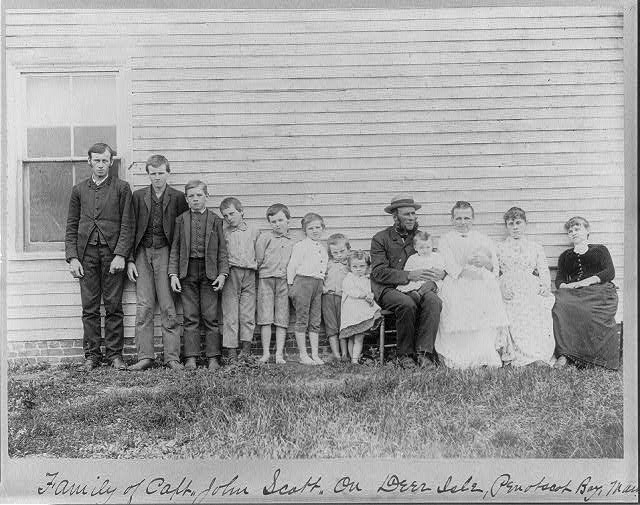
Joesph married Barbara Scott Mar 25 1807 at Durham, Androscoggin County, Maine Barbara was the daughter of John Scott and Mary (Burnham) Scott. Capt. John Scott came to Durham in 1791 from Portland and married April 1 1782 Mary, dau. of John and Abigail (Stickney) Burnham. He was a sea-captain. Died in Durham 3 April 1803. His wife was born in Portland 29 Dec. 1762. Below is a descendant John Scott grandson and his family
Barbara Scott was born Nov. 17, 1787 in Durham Androscoggin County Maine. She died Oct. 12, 1841 in Portland Cumberland County Maine. He married (2) November 16 1842 Mrs. Mary Ann Hersey, who died 28 Mch. 1897. He died in Portland 30 April 1853. According to The Mayflower Descendant Volume 42 January 1992 Mary Anne Brown was married to Jeremiah Hersey.
Children of Joseph M Gerrish
Adeline Gerrish born December 23 1808; married November 2 1828 Wm. E. Edwards of Portland. Died 11 Jan. 1875. He died 16 Sept. 1877
Frances Ann Gerrish Ordway (1810 - 1895) married 1st January 7 1830 at Portland Maine to William Bartol. 2nd m to Reuben Ordway 28 Jun 1842
Joseph Augustus Gerrish (1812 - 1813)
Martha Martin Gerrish born March 10.1814; married August 12 1833 Rufus Read of Portland. Died 26 Sept. 1847. He died 9 Sept. 1848.
Ellen Lucretia Gerrish (1816 - 1817)
Joseph Merriner Gerrish JR (1817 - 1836)
Edward Payson Gerrish born November 8 1819; married May 9 1844 Julia W. Scott. Died November 26 1871.
Augustus Franklin Gerrish born July 30 1823; m. 27 December 27 1848 married Caroline Elizabeth, daughter of Col. James March of Gorham.
Frederick Augustus Gerrish (1824 - 1873) married September 25 1849 Martha J. Ordway.
William Oliver Scott Gerrish (1827 - 1831) married 1854 Hannah Bailey. Died 29 June 1887.
Mary Kidder Gerrish (1828 - 1831)
According to Gorham records: In 1808 Mr. Mosher built on his farm the house since owned and occupied by Freeman Richardson. This house was not completed until 1831, when Joseph M. Gerrish of Portland bought the place and finished the house, throughout. Mr. Gerrish lived in Gorham until 1837, when he returned to Portland.


MAINE ENCAMPMENT, PORTLAND, MAINE.
Charter, March 17, 1821.
PAST COMMANDERS.
Willed under the Jurisdiction of the Grand Encampment of Massachusetts and Rhode Island.)
Rev. Sir Solomon Siab. Sir Joseph M. Gerrish.
Sir Thomas S. Bowles. Sir Samuel Fessenden.
Maine Encampment ceased to be under the jurisdiction of the Grand Encampment of Massachusetts and Rhode Island, Oct. 10, 1849, In 1864 it was removed from Portland to Gardiner, where it is now located. The late Joseph M Gerrish, Esq Date: Tuesday, May 24, 1853 Paper: Portland Weekly Advertiser (Portland, ME) Volume: LV Issue: 21

From [Joseph M. Gerrish; Respected; Succeeded]
Date: Tuesday, February 20, 1838
Paper: Portland Weekly Advertiser (Portland, ME)
Volume: XL Issue: 20 Page: 4


Grave photo by Bonnie Maskery Augustus F Gerrish A Fortunate Maine Man Date: Wednesday, December 11, 1872 Paper: Portland Daily Press (Portland, ME) Volume: 11 Page: 3

Edward Payton Gerrish
Grand Patriarch of the Grand Encampment of Masonic Maine Lodge
Portland Loan & Savings Incorporated in 1854:
Nathaniel F. Deering, President. Edward P. Gerrish, Vice President. Edward Shaw, Secretary. Harris C. Barnes, Surveyor. John H. Williams, Attorney. Nathaniel Ellsworth, John Purinton, James Crie, Charles Davis, Benj. Kingsbury, Jr., Thomas II. Talbot, Charles R. Coffin, Directors.
Title: Edward P. Gerrish Date: Monday, November 27, 1871
Paper: Portland Daily Press (Portland, ME)
Volume: 10 Page: 3

Joseph M Gerrish JR

From Sons of the American Revolution by Nathan Gould
Augustus Franklin Gerrish, Portland Me. Son of Joseph Marriner and Barbara (Scott) Gerrish, grandson of Nathaniel and Sarah (Marriner) Gerrish, great-grandson of Charles and Mary (Frost) Gerrish. Charles Gerrish was a Major in the Second Massachusetts Regt. of Militia, Col. Jonathan Mitchell, in 1776.
Son of Joseph Marriner and Barbara (Scott) Gerrish, grandson of John and Mary (Burnham) Scott. John Scott was a private in Capt. David Bradish's Co., Col. Edmund Phinney's Regt., in 1775, also a Matross in Capt. Abner Lowell's Co., stationed at Falmouth four months in 1776. His widow received a pension.
Son of Joseph Marriner and Barbara (Scott) Gerrish, grandson of Nathaniel and Sarah (Marriner) Gerrish.
Nathaniel Gerrish was a private in Capt. John Worthley's Co., Col. Edmund Phinney's Regt., enlisted May 8, 1775; served eight months at Cambridge.
Son of Joseph Marriner and Barbara (Scott) Gerrish, grandson of John and Mary (Burnham) Scott, great-grandson of John and Abigail (Stickney) Burnham. For the services of John Burnham.

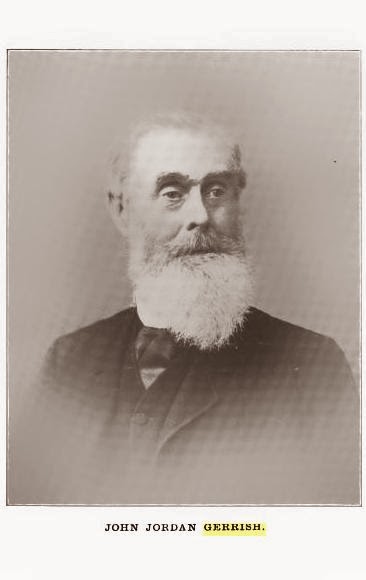
John Jordan Gerrish, Portland, Me. Son of James and Mary (Sylvester) Gerrish, grandson of George and Mary (Mitchell) Gerrish, greatgrandson of Charles and Mary (Frost) Gerrish. For the services of Charles Gerrish
Augustus married Caroline Elizabeth March, Dec. 27, 1848


