Showing posts with label Anthony Davenport. Show all posts

Tuesday, October 13, 2015

Old South Chapter Daughters of the Revolution Laura Wentworth Fowler at Wolfe Tavern to explore Auld Newbury 1900


Old South Chapter (Boston, Massachusetts).—The Daughters of the American Revolution seek historic facts not only in the dusty tomes of the library, but by pilgrimages to places where Revolutionary history was made. This chapter, Mrs. Laura Wentworth Fowler, regent, enjoyed three "outings" this year. Daughters of the American Revolution Magazine, Volume 17 1900. The affections of the members of the Old South Chapter cling to the name "Old South;" so it was fitting that they should accept.an invitation from the Old South Historical Society through its energetic president, Mr. Joseph Parker Warren, to join it in its annual historic pilgrimage, which this year was to Newburyport and "Auld Newbury." Newburyport has its memories of Louisburg and the Plains of Abraham. See Captain William Davenport & His Company 1759 Newbury MA
A bomb-shell from Louisburg adorns a street corner, while the "Wolfe Tavern" was the rendezvous of rebellious spirits in the days of the stamp act. A bell, cast by Paul Revere, rang out a merry welcome from the Old South Church, where, in 1775, was formed the first volunteer company organized for service in the continental army. Under the pulpit lie the remains of the Rev. George Whitefield, and a cenotaph in the church bears witness to his many virtues and great eloquence.

The town sent out many privateers during the Revolutionary war. William Davenport's son Anthony Davenport was among them and furnished supplies for the troops at Lexington and Bunker Hill. A little find on the Davenport family from the Boston Post old newspaper.


Also the infamous  Nathaniel Tracy fitted out a great fleet, consisting of 24 cruisers, with 340 guns and 2,800 men. He also contributed $160,000 to the cause of liberty. His fine old mansion is now the public library and museum. The old Dalton house, now the home of the Dalton club, retains its fire-places with their exquisite carvings and Corinthian pillars reaching to the ceiling. In a frame upon the wall is a sample of wall paper similar to that seen in the Quincy house. 
On the label it is stated that it had "been used to adorn the room in which Mary Dalton was married to Leonard White."
By trolley the party, numbering six hundred, were taken through High street, where dwelt Caleb Cushing, Lord Timothy Dexter and other notables, to "Auld Newbury," six miles away, where the inner man, who cannot thrive upon tradition, was refreshed. On return to Newburyport, the birthplace of William Lloyd Garrison, the office of Theophilus Parsons (where Robert Treat Paine and John Quincy Adams were apprentices), and the First Religious Society, a church of pure colonial build, were visited, and then a steamer conveyed the party fifteen miles up the river to Haverhill. From that point, the return to Boston was quickly made by special train.
The three field-days of the Old South Chapter for 1900 will ever be remembered as days of unalloyed pleasure.


The Chapter is entertained by the Daughters in turn, and this season many have received at the "Wolfe Tavern," a hostelry of some historic note, although modern in its present appointments.

     Wolfe Tavern: It dates from 1762, and its first owner and proprietor, Captain William Davenport, raised a company of Newbury men at the time of the French and English War and were present with them when General Wolfe was killed on the Plains of Abraham. After Captain Davenport returned to Newbury he opened a tavern and with a natural enthusiasm for his General he named it the "Wolfe Tavern," and from the cross beam of a lofty pole he suspended a sign bearing the head and bust of General Wolfe surrounded by an elaborately carved and gilded wreath, all the work of his own hands. During the Revolution this sign barely escaped destruction assome thought it "an insult to the inhabitants of this truly republican town." 

Sign is now at the Museum of Old Newbury (formerly the Ould Newbury Historical Society) in Newburyport, Massachusetts Wolfe Tavern History Page

Subsequently the original sign was destroyed by the great fire of 1811, and in front of the present tavern a new sign bearing the portrait of General Wolfe, painted by Moses Cole, a French refugee, was suspended where it now swings. 
By reason of her absence from Newburyport during the winter season, the very capable and gracious Regent, Miss Edith Russell Wills, who has been Regent of the Chapter since its inception, resigned and the Vice-Regent, Mrs. Lawrence Brown, was unanimously elected to succeed her. As Mrs. Brown ably fills the office every indication promises a successful future for the Chapter. From Daughters of the American Revolution Magazine, Volume 15


78 High Street Newburyport  Land bought in 1807 by Anthony Davenport and the house built soon afterward, passing in 1838 to his daughter, Mrs. Samuel T. DeFord (Catherine Greenleaf Davenport m1st Damuel DeFord, 2nd Augustus Pearson). It remained in this family until 1871 when bought by John A. Greeley, John Balch Greely and Frances Dunn Cobb and brother to Adolphus. Anthony Davenport, Sr was a famous privateer See Naval records of the American Revolution: 1775-1788*


Photo and information from Family Findings
No woman is better known in Boston’s musical and club circles than Laura Wentworth Fowler, daughter of Amasa Wentworth and Susan (Nowell) Wentworth, born in Somersworth, New Hampshire June 11, 1837. She is a descendant of Elder William Wentworth, from whom Lieutenant-Governor John Wentworth, and Governors Benning and John, Wentworth also descended. Four of her ancestors fought at Bunker Hill, which admits her to the Daughters of the American Revolution.


She early displayed rare musical ability, and at the age of eleven began to play the organ in church. Graduating from Abbot Academy, Andover, Mass., in 1860, where she taught music during her course, she took charge of the musical department of Lagrange Female College, Tennessee, but returned North in a year on account of the war, and became teacher of mathematics, languages, and music in the Concord (N.H.) High School.
During her second year here, she was called to the musical department of Monticello seminary, Illinois, remaining four years. Returning East she took charge of the departments of music and painting in Elmira College, New York, which she directed successfully until her marriage, six years later, with William Fowler, a gallant officer of the Union army during the war, who died November 26, 1874. Subsequently she taught eight years in Kentucky. Mrs. Fowler has superior literary as well as musical abilities, and is a prominent member of the N.E.W.P.A. She is a life member of the Bostonian Society, being the first woman admitted; a member of the New Hampshire’s Daughters, director of the Massachusetts Federation of Woman’s Clubs, and vice-president of the General Federation of Clubs of America. She is also connected with a score of other clubs and organizations, among which her favorite is the Abbot Academy Club, of which she is president and founder. Mrs. Fowler is endowed with a charming personality, and her chief characteristics are tact, will, energy, and enthusiasm.


Article published in the October 2, 1953 Newburyport Daily News.
 

Wednesday, December 31, 2014

Norman C Greenbough Newburyport


BRYAN EATON/ Staff Photo. A nineteenth century chronometer made of walnut wood and brass by watchmaker Norman C. Greenough. He moved to Newburyport in 1851 and set up shop off Market Square. His photo is pictured at left.


Presentation--Complimentary Date: Thursday, December 6, 1855 Paper: Salem Register (Salem, MA) Page: 2


Norman was son of Brackett L Greenough and Abigail Cummings. He married Francis Davenport DeFord (1816-1887) daughter  Samuel Tibbett DeFord and Catherine Greenleaf Davenport daughter of Anthony Davenport and Catherine Greenleaf .


Monday, August 4, 2014

First Fire Society Newburyport Articles 1746

Firemen Of Old Saturday, July 6, 1872 Colombian Register (New Haven, CT)  Page: 3


Photos From History of Newburyport, Mass 1764-1905, Volume 2 By John James Currier
Some history on Fire Societies
FIRE SOCIETIES AND FIRE ENGINES.
Dr. John Spraguc, who came to Newbury previous to 1738, was a member of one of the societies organized for the purpose of preventing, if possible, the destruction of property by fire. A leather bucket, formerly in his possession, bearing his name and the date of 1746, is shown in the half-tone print on this page. The bucket is now in the possession of Miss Jane R. Wood of Newburyport. Another bucket, an exact duplicate, is in the possession of Mrs. Margaret (Andrews) Allen of Madison, Wisconsin.
The Dernier Resort Fire Society, consisting of thirty members, was organized as early as 1760. Ralph Cross, Caleb Cross, Lemuel Collin, Nathaniel Knapp, Isaac Knapp, John Mycall, Timothy Palmer, Leonard Smith, Abraham Williams, Robert Williams and others were members of the society. According to the rules and regulations adopted at that date, and afterwards revised and printed, each member was required to keep at his residence two leather buckets and a knapsack containing two canvas bags ready for use at all times. Two of these leather buckets, formerly the property of Ralph Cross, are now in the possession of the Newburyport Marine Society.
In December, 1775, the Marine Fire Society was organized. One of the articles of association adopted provided that no person shall be elected a member of the society
"unless he be a member of the Marine Society of Newburyport."
The second article reads as follows :—
Each of us will also keep in good order, hanging up in some convenient place in our respective dwellings, two leather buckets, in which shall be two bags, each bag measuring one yard and a half in length, and three-quarters of a yard in breadth, being hemmed at the mouths, and having strong strings to draw them close; the buckets and bags shall be marked with the first letter of the owner's Christian name and with his surname at length, under a penalty of three shillings for each deficiency.'
Moses Brown, Jonathan Parsons, Peter LeBreton, William Farris, John O'Brien, Benjamin Rogers, Henry Lunt,Nicholas Johnson, Charles Hodge, David Coats, William Coombs, Joseph Newman, Michael Hodge, William P. Johnson, Edward Wigglesworth, Ebenezer Stocker, William Nichols and others were members of this society. It was not dissolved until the close of the year 1833, and perhaps later. Two leather buckets, formerly the property of William Nichols, captain and part-owner of the privateer Independence in the Revolutionary war, are now in the possession of his grandson, George E. Hale of Newburyport. A photograph of these buckets, taken for the illustration of this sketch, is reproduced in the half-tone print on this page.
The Union Fire Society was organized February 28, 1783. Benjamin Frothingham, Edward Toppan, William Cross, Daniel Balch, jr., Abraham Jackson, Daniel Coffin, Richard Pike and other well-known citizens of Newburyport were members of this association. Meetings were held usually at Wolfe Tavern. The half-tone print on the next page is reproduced from an engraving in the possession of the Essex Institute, Salem, Mass.
The Federal Fire Society was organized in 1791. At that date the prominent members of the society were James Hodge, Nathaniel Knap, jr., Isaac Knap, jr., Edward Sweat, jr., Abraham Perkins, William Wyer, jr., David Wood, Joseph Swasey, jr., and John Greenough.

Sources:
See Newburyport Town Records @ PEM
Articles and regulations of the Relief Fire Society, in Newburyport : formed the twenty-first of March, 1775.

Friday, November 15, 2013

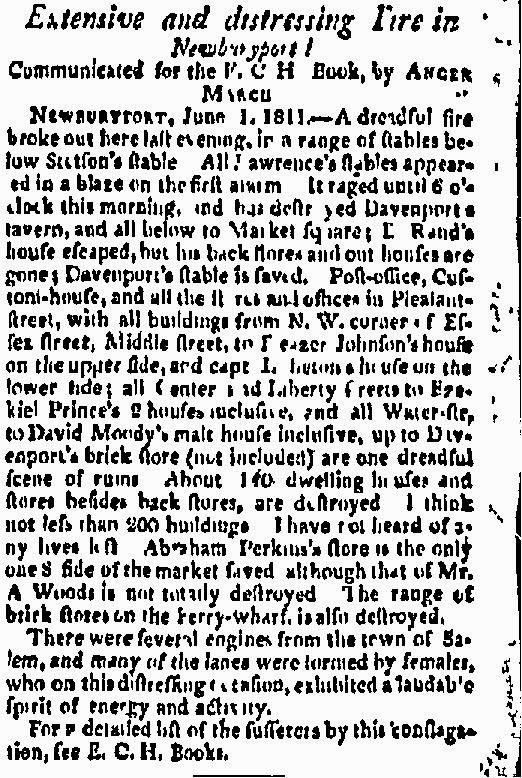
Newburyport Fire 1811 Historical Accounts


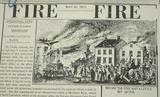
On May 31, 1811 Newburyport was devastated with "The Great Fire" which broke out shortly after 9PM.    Here are some historical references and accounts.  See Article 


Another Great Source:  Jonathan Plummer "Great and Dreadful Fire at Newburyport. Fire, Fire, Fire: An Ode and a Sermon, Concerning a Tremendous Fire at Newburyport, which Commenced on the Evening of the Thirty First of May, 1811" Check out this great site with more on on Plummer and Timothy Dexter 

Independent Chronicle 
June 3, 1811


From History of Newburyport : from the earliest settlement of the country to the present time : with a biographical appendix Euphemia Vale Blake:


Nearly two hundred and fifty buildings were thus totally and suddenly consumed, including almost every dry goods store, four printing offices, the Custom House, surveyors' office, post office, two insurance offices, the "Union"  and the " Phoenix," the Baptist meeting-house, four attorneys' offices, four book stores, (the loss of one of these was $30,000,) and also the Town Library. Blunt's building, a massive structure four stories high, and the Phoenix building, for awhile seemed to present an effectual barrier to the farther progress of the flames ; but by a sudden change of the wind they were carried directly upon these immense piles, which were soon involved in the general calamity. " State street at this time presented a spectacle most terribly sublime! The wind, soon after it changed, blew with increased violence, and these buildings, which were much the highest in the street, threw the fire in awful columns high into the air, the flames extending in one continued sheet of fire across the spacious area!

From Savannah Republican (Savannah, GA)  Date: June 22, 1811 Volume: IX  Issue: 75 


From Caleb Cushing's History of Newburyport:


But in addition to the evils arising to us from the cupidity of the European belligerents, and the restrictive and retaliatory measures into which this country was consequently driven, Newburyport was doomed to suffer by a peculiar misfortune. This was the great fire of 1811, which desolated the busiest portion of the town, by its destructive ravages; and whose effects still meet the eye, in the depopulation of streets formerly filled with dwelling-houses and shops.
This conflagration commenced in a stable in Mechanic Row, near the Market Square, and of course in the center of the portion of the town devoted to trade and business. The stable was at the time unoccupied, and when the fire was discovered was found to be completely enveloped in flames. This was at half past nine o'clock in the evening of the thirty-first day of May, 1811. The fire quickly extended to Market Square on the one hand, and to State street on the other, and soon spread in various directions, with a degree of celerity and fury which baffled all exertions to stop its progress. The fire continued to rage until about two o'clock in the morning, soon after which its violence diminished; and by sunrise it had in a great measure subsided, after having swept away everything on a tract of land of sixteen and a half acres, leaving there only a mass of deplorable ruins. No part of the town was more compactly built than this; none contained so large a proportion of valuable buildings, merchandise, and other property. Indeed, the compactness of the buildings, which were chiefly constructed of wood, served constantly to feed the flames with combustible materials, so that for a time the destruction of the whole town was seriously apprehended. It was estimated that nearly 250 buildings were consumed, most of which were stores and dwelling-houses. This number included nearly all the shops in town for the sale of dry goods; four printing-offices; the custom-house; the post-office; two insurance offices;four bookstores; and one meeting-house; and the dwellings of more than ninety families.


[merged small][merged small][merged small][merged small][merged small][merged small][merged small][merged small][merged small][merged small][merged small][graphic][merged small][merged small][merged small]


From An account of the great fire, which destroyed about 250 buildings in Newburyport, on the night of the 31st of May, 1811. Taken principally from the statements which have appeared in the public newspapers:

Newburyport, July 30, 1811. The Selectmen of Newburyport acknowledge the receipt of twenty four thousand three hundred and five dollars and. fifty-five cents from the citizens of Boston, to be appropriated to the relief of the sufferers by the late fire. At a time when a spirit of Charity, as large as our exigencies were imperious, seems to have pervaded our sister States ; whilst the benevolence of every part of the country has been most liberally displayed towards us, your bounty has been most liberally displayed towards us, your bounty has been eminently distinguished...from Newburyport Herald July 18, 1811


from The Panoplist, and Missionary Magazine United, Volume 4; Volume
FIRE AT NEWBURYPORT,

Thanks correspondent, who furnished the list of donations to the sufferers by the fire at Newburyport, has transmitted some corrections of that list, and several additions, which we here subjoin: Becket $12 99 Blandford 31 00 Belchertown 16 00 Boylston 40 U0 Berkshire \Vash. Ben. Society 80 00 Berwick, Rev. N. Lord’s Soc. 6 69 Carried forward 186 68

Popular Post