Showing posts with label Benjamin Greenleaf. Show all posts

Saturday, May 17, 2014

Bradford Academy Braddford MA


An Act to establish an Academy in the West Parish in the Town of Bradford, by the Name of Bradford Academy. [This Act passed February 10, 1804.] "Laws of the Commonwealth of Massachusetts, from November 28, 1780 to February 28, 1807" In 1932 the academy became Bradford Junior College.
The Bradford Academy in the West Parish of Bradford, was incorporated in 1804; tuition from 4 dollars to 6 dollars a quarter. 


Benjamin Greenleaf, was the last principal---He was the son of Caleb, who was the son of Timothy, who was the son of John, who was the son of Samuel, who was the son of Stephen, who was the son of Edmund, born in England in 1600. On the 12th of December, 1814, Mr. Greenieaf became the Preceptor of Bradford Academy. From A memorial of Bradford Academy: In 1810, Benjamin Greenleaf was entered as a sophomore in Dartmouth College, in a class of sixty. A quote from his diary.

"Sept. 26th, 1810. Exhibition Day at Atkinson; spoke the valedictory oration. Had a large ball in the evening; Betton, Nichols, and myself were managers.
"27th. Went to Haverhill in the morning for my horse, and set out for Dartmouth College, and take my farewell of Atkinson Academy. Arrive that day with Nichols and his father at Concord, and put up
"29th. Arrive at Hanover 8 of the clock, A. M. At a' quarter past 9 offer myself for examination before the officers of the College. After one hour and three quarters, was admitted to a regular standing in the sophomore class without any difficulty."

If there was anything striking in his scholarship while in college it was in the mathematical line, an indication of which we have in the fact that he calculated and sketched the transit of Venus while there, an event to take place December 8, 1874. He was the first to work this problem in Dartmouth College. After graduation he taught in Haverhill.

He married Lucretia Kimball, a teacher at the academy and former student.  Lucretia was the daughter of Capt. James Kimball and Lucretia Haseltine born 28 Feb 1794 in Bradford, Essex, MA, and died 02 Oct 1880 in Bradford, Essex, MA-Elmwood Cemetary. She married Benjamin Greenleaf on Oct 1821 in Bradford, MA. see The Kimball Family News, Volumes 3-4

More About Lucretia Kimball and Benjamin Greenleaf:
Marriage: Oct 1821, Bradford, MA.
Children of Lucretia Kimball and Benjamin Greenleaf are:
  1. James Kimball Greenleaf, b. 31 Dec 1832, d. 07 Mar 1834.
  2. Lydia Kimball Greenleaf, b. 14 May 1836.
  3. Moses Poor Greenleaf, b. 07 Feb 1818, d. 23 Jan 1848.
As a Teacher, Mr. Greenleaf was popular and successful. He had, at different times, as many as three thousand pupils under his care. More than two hundred of these afterward became connected with colleges; many of them entered the Christian ministry, and more than forty the legal profession. One of them thus distinctly reproduces a portrait of Mr. Greenleaf as he appeared in the school-room, and before his classes, and in social life, in his early days at Bradford. We quote from a letter of the Honorable Ira Perley, Chief Justice of the State of New Hampshire.

"I entered the Academy in April, 1816, and remained till the end of the summer term in 1818. His personal appearance and manners were marked and somewhat peculiar. Everything in the man was frank, direct, and wholly unaffected. Though very plain and perhaps a little careless in his dress, he was always perfectly tidy and scrupulously neat. His manners were not much regulated by artificial rules of politeness; but he had, what is much more important, great real kindness of heart, and habitual regard for the feelings of others. His loud voice and abrupt address were perhaps the more remarked from their contrast with the easy self-possession and calmer dignity of the excellent lady who presided so long over the other department of the school. He was understood to have an excellent head for mathematics, and to have pursued those studies with success.

"I do not think that the range of his classical studies was very extensive. But he had drilled himself, as well as his pupils, very faithfully in the Latin and Greek books which he taught, and his tastes did not lead him a great way beyond. He took greater pleasure, as I have always understood, in solving a knotty problem in mathematics, than in the perusal of a Latin or Greek classic. He, however, shirked no duty, and taught with great fidelity and diligence such of his pupils as were learning Latin and Greek. Indeed, he entered with great zeal and energy into all his work, and had that invaluable and indispensable gift of a good teacher, the faculty of imparting some of his own earnestness to those whom he taught. They could not fail to perceive that he was deeply interested in their improvement, and took great pleasure and pride in their success. He was devoted to his business of teaching, and justly regarded it as of the highest importance. It is quite clear that he chose the profession for which his natural endowments and all his training and habits had best qualified him.

"When I was there the school was very orderly, without any severity, or much sternness of discipline. I never knew the discipline to go beyond a rough and round reproof, except in a single instance, when a contumacious young man was expelled, after calling a meeting of the trustees to deliberate on his case.

"Mr. Greenleaf was very arduously devoted to the work of the school, and the studies immediately connected with it. I never knew that he had anything of what is commonly regarded as amusements or recreation— no games like chess or backgammon, no rides or even walks, for exercise. He sought no relief from the routine of his daily work in novels, poetry, other light reading.

"Mr. Greenleaf was a thoroughly sincere and honest man. He was wholly incapable of disguise or false pretense. He had but one way of accomplishing an end, and that was the most direct. And yet he was a prudent and sagacious man, and singularly fortunate, I believe, in avoiding personal differences and disputes. His moral and religious principles I believe to have been very firmly established, and made the uniform guide of his life. His influence was all on the side of religion and virtue. His numerous pupils who survive him will always cherish the memory of his kindness and devotion to their welfare."


Miss Harriet Briggs, daughter of Dr. Calvin Briggs of Marblehead, Massachusetts. "She was then a teacher in Bradford Academy, so hallowed by the memory of Harriet Newell and the first Mrs. Judson." With beauty of person and sweetness of natural disposition, she united a high degree of intelligence and culture, and a rare devotedness to the service of Christ. Her missionary spirit is told in a single line of a letter from Mr. Stoddard shortly before leaving the country. "As I write the date of this letter, I am forcibly reminded that the time is rapidly coming when I shall bid you farewell, and set my face toward Jerusalem. But as Harriet says, so say I—' When I think of the trials that will come upon me, my heart does not shrink.'" These two kindred hearts were united in marriage,.February 14th, 1843. From Memoir of Reverend David Tappan Stoddard By Joseph Parrish Thompson

Marion Coats, Principal of Bradford Academy, is hired as President-Designate of Sarah Lawrence College for Women 1929


Some Notable Dames of Bradford Academy:
   
Harriet Atwood Newell (1793-1812) She was member of the first American missionary venture. See Memoirs of her life. Pioneer of American Foreign Missions
 

Ann Hasseltine Judson (1789 - 1826) was one of the first American missionaries. In February 1812, she married the Rev. Adoniram Judson, one of the first members of the newly established American Board of Commissioners for Foreign Missions


Caroline Atherton Mason  Poet. She and her seven sisters attended the nearby Bradford Academy, where they were collectively nicknamed "the Pleiades."

MarianTrue Gehring  Helped to establish Gould Academy


Portia Marshall Washington Pittman (June 6, 1883 – February 26, 1978), the first Black graduate of Bradford Academy in 1905. Musician and teacher, and the only daughter of Booker T. and Fanny (Smith) Washington

   
Mary Montague Smith. She was first City Librarian. She was educated in the Bradford Academy, MA


Mabel Wheeler Daniels


More Info
"Historical Collections" By John Warner Barber
Historical Sketch of Harriette Briggs Stoddard: Bradford Academy By Mrs. J. D. Kingsbury
          

Thursday, July 18, 2013

The British are coming! Or not

My article in Newburyport News


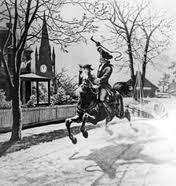
The celebration of our independence is fast approaching, and while we all know the story of the infamous dispatcher Paul Revere and his midnight ride to warn Adams and Hancock that the Brits were coming, many are unaware that Newburyport had a Revere as well. Ebenezer Todd made tracks through the dusty trails and back roads of Newbury to “warn and save” just like Revere, only in his case, it was a false alarm. This wicked tall Tory tale from the archives lasted only a night, but managed to ignite a sizzling terror in the Port and, for you present natives, a cool chronicle tidbit for a hot season.

John Greenleaf Whiitier

John Greenleaf Whittier called the event the “Great Ipswich Fright” because the whole debacle originated when a rumor starting circulating that British “regulars” had landed on Ipswich shores to execute a large-scale invasion to free prisoners jailed there. This mishap created quite a commotion, and like “most news, it spread like wild fire, being generally credited, and the consternation became almost universal” (Coffin, History of Newbury).
           
On Friday April 21, 1775, Todd, by order of “officials” from Rowley, broke up a community meeting hosted by Parson Carey, who was just about to give his opening prayer to comfort his flock and bring news of the fighting at Lexington. Todd approached the meetinghouse with “hurried hoof-beats” and stormed through the doors with “loosed haired and painting for breath,” shouting:
"For God's sake, turn out! turn out! or you will all be killed!
The regulars are marching this way, and will soon be here.
They are now at Ipswich cutting and slashing all before them…
By this time, they are at Old Town Bridge."

According to Currier (History of Newburyport), “all sorts of ludicrous things were done by men and women to escape impending destruction.” Crazed and frightened town folk scurried like mice from a hungry wild cat. Vehicles and carriages flooded the streets, and many headed for safer terrain on foot as well. Additional Revere wannabes added to the panic, screaming, "Flee for your lives! Flee for your lives! The regulars are coming!"


One man hid private documents under a large stone in his field and battened down the hatches with musket in hand, “resolved to sell his life as dearly as possible” (Coffin). Another woman threw all her precious silver in the well, but her fresh, hot pies were another matter – no rebel would get a taste of her tarts. There is also a report of one confused woman who ran five miles before making a pit stop on the steps of Reverend Noble's meetinghouse to nurse her infant, only to discover she grabbed the cat instead.
In many cases, the able-bodied left those who were bed ridden or elderly to fend for themselves. One feisty fellow, “whose excessive corpulence rendered retreat on his part impossible, seated himself in his doorway with his loaded king's arm” and mustered his neighbors to "stop and shoot the devils" (Coffin).


Several headed for safety by boat to Salisbury. One man, while escaping to Ring’s Island, almost sacrificed his little tyke when anxiety reached a critical point, shouting to his wife, "Do throw that squalling brat overboard, or we shall be all discovered and killed!"
             
As the tale grew more gruesome, the great panic eventually spread as far as Haverhill and into New Hampshire. “Almost simultaneously, the people of Beverly were smitten with the same terror. It was then believed that the enemy had fallen upon Ipswich and massacred the inhabitants, without regard to age or sex” (Salem Gazette). At one point, the destruction of the Parker and Thorla bridges was proposed, but thankfully, a handful of concerned citizens decided that it would be wise to validate the claim before repeating it. They soon discovered it had no credence.
Benjamin Greenleaf

Finally, Eliphalet Hale of Exeter rode from Ipswich to Newbury in fifty minutes. He let all who came in his tracks know that it was a hoax. The following day, Benjamin Greenleaf addressed the false accounts in a letter to the Committee of Safety in Boston, asking them to call off the troops. Even so, the fear of invasion by sea was real, and for the next few months, all who endured this great fright took extra precautions.
           
John Jenks of Salem reported in his journal that despite the false alarm, he “moved [his] goods up to Uncle Preston’s in Danvers and a great number of teams were employed to carry provisions out of town.” Ipswich ordered “a guard of two men [to be] stationed by the Town on the Hill in May 1775. A flagstaff was erected, and a beacon, and in case of the appearance of the enemy, a flag was to be displayed by day and a fire, built of tar and other inflammable material to be kindled by night” (Ipswich Chronicle).
           
Although the phrase “don’t shoot the messenger” was the law of the land, many felt that this bearer of bad tidings should be the exception, but since Ebenezer Todd acted as any good Patriot would have, he was pardoned. Whittier commended the citizens of Newburyport for their courage despite the sham, noting that “they might bow and sway like reeds in the wind; but they stood up like the oaks of their own forests beneath the thunder and the hail of actual calamity.”

Good People of the Port - Have a Happy 4th of July!

Popular Post